


Tax Credit Incentives Are Just One of the Project Location Tools

“We were gonna make a whole world like this. Now, everyone used to come here, but you know… you know what it feels like when all your teeth are falling out really slowly and you don’t realize and then you notice that, well, they’re really far apart.” – Carol, “Where the Wild Things Are,” Warner Bros, 2009
With all of the confusing, exciting changes taking place in the industry, you’d think studios everywhere would be celebrating this year.
Despite the fact that that the industry is recording numbers that are more than 15 percent lower than in 2022, film and show production is steadily ramping up after two dismal years.
Last year, 2-2500 projects were globally released.

More than 675 movies, 313 scripted projects, 170 feature films, more than 750 original TV shows and more than 650 unscripted projects were released in the Americas and are in the pipeline.
The Middle Kingdom churned out more than 620 films led by Beijing Enlight Media’s animated blockbuster, Ne Zha 2, which is the fifth highest grossing film globally of all time with ticket sales approaching $2.5B worldwide.

The global success of the Chinese project stimulated renewed interest in fresh, interesting, animated films/shows around the globe. There were projects from nearly 20 countries across Europe, Asia and the Americas highlighted at this year’s Annecy film festival with some featured at other festivals.
Of course, Netflix sorta knew the genre was real back in 2014 when they added their first anime project, Knights of Sidonia.
Since then, they have steadily increased their anime library with films/shows from South Korea, Japan and other countries and Disney, WBD have quickly followed suit. Netflix’s early moves, as with many of their global “sensations,” were in response to country regulations which dictated that 30-40 percent of the projects shown in the respective country had to be produced locally.
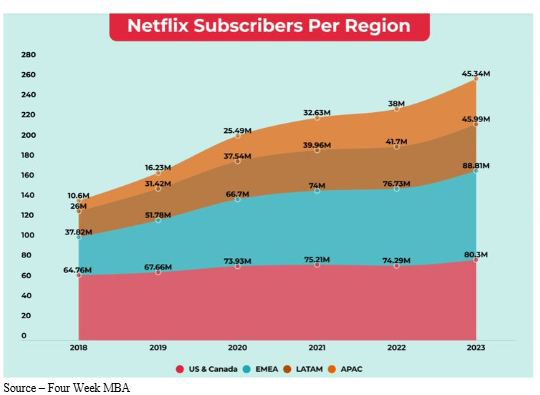
The projects quickly found eager audiences regionally and then globally as the company focused on growing its subscription base to more than 340M … everywhere but China because of rigid content “rules.”
While (Ted) Sarandos hasn’t been eager to share the company’s global content with the 1.5B Chinese citizens, Netflix has been able to acquire projects such as Green Snake, Yin-Yang Master, Wandering Earth, Dynasty Warriors and more.
A sensible, logical, patient approach may enable Netflix to open the Chinese entertainment-hungry audience to the company’s global films/shows; but until then, they are focusing on growing their global audience elsewhere.
The entertainment industry, more than most and certainly more than government officials, understands that they need to focus on long-term objectives and consistency for their audience(s).
And they’re not alone as studios place their big bets on major franchises (sequels, reboots, extensions) for theatrical release with shortened release windows. And then they and streamers use theatrical windows for word-of-mouth marketing and award qualification.
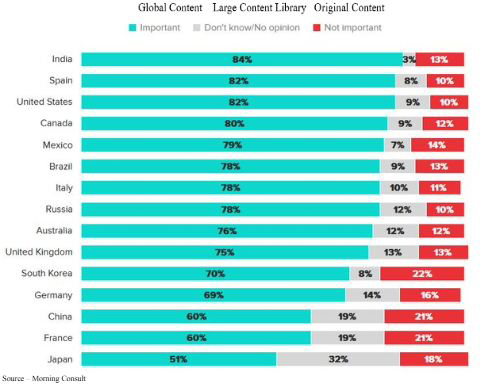
Global audiences have redefined how they prefer to watch movies – 70 percent favor streaming.
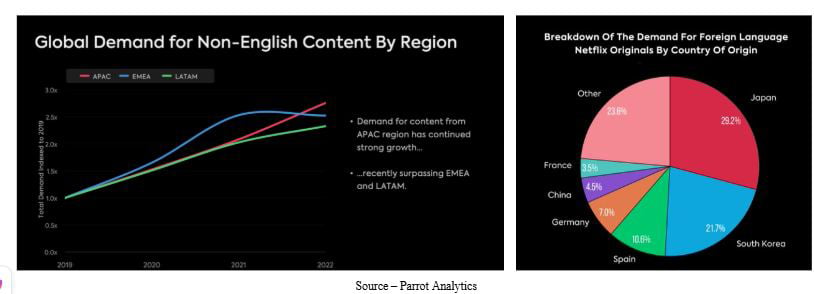
And as streamers expand their global reach, they are also finding increased viewer demand for non-English movie and show titles.
Even under these hybrid distribution conditions, this wouldn’t be a big concern for content creation centers such as Hollywood since content production investment is projected to approach nearly $250B this year.
However, studios and streamers are weighing not only the location of content origin but also labor costs, financial incentives and indirect costs.
Granted, labor costs have risen in Hollywood following the two strikes; but for most folks involved in content creation, production and post work it has benefited crewmembers regardless of where they are located.
The major shift has occurred because finally, there are plenty of choices of leading-edge studio facilities across the Americas and in a growing number of countries.In addition, the areas have heavily invested in infrastructure to provide state-of-the-art equipment and systems as well as well-trained and qualified project personnel to meet the creative quality needs of film/show production managers.
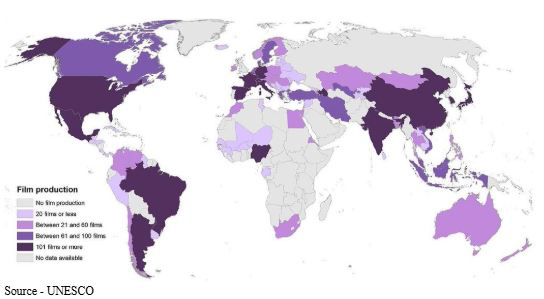
Just across the North American border, major film/show production locations in Vancouver, Toronto and Montreal have become increasingly attractive to US project owners because of their scenic landscapes, cultural diversity, infrastructure and economic incentives.
Britian, France, Germany, Spain, Italy and significant Eastern European regions have steadily emerged as local and international production hubs.
South Korea, Japan, Singapore, and other notable APAC countries have expanded/upgraded facilities to provide cost-effective locations as well as meaningful government incentives.
Egypt, Jordan, UEA, Saudi Arabia have heavily invested in new facilities from the ground up with the strong support and financial commitment from major organizations and national/local governments.
India, New Zealand and Australia have a long history in a broad range of production technology, have invested heavily in training people in the various trades and opened their doors to increased film/show production.
Even here at home, cities, states and major firms have undertaken aggressive studio development efforts to provide film/show friendly locations and well-trained crews in places that include New York City, Atlanta, Austin, Louisiana, Illinois and Massachusetts.Film/show production has been done for decades outside the US with European, Asian and South American studios booked months and years in advance.
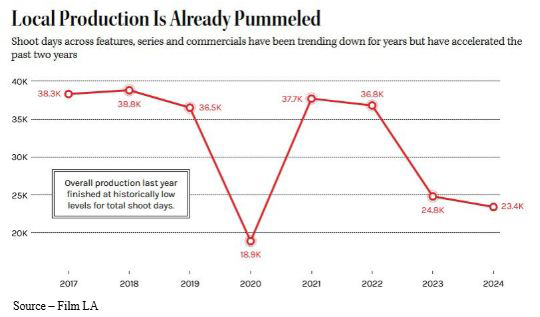
While film and TV production has decreased in Hollywood by more than a third over the past 10 years, there was still projects they could count on – game shows, reality/unscripted shows and advertising.
But thanks to the overhanging shadow of the Southern California fires and lack of competitive incentives, even these have slowed to a crawl.
Increasingly, the area is inflicting damage on itself, almost encouraging films/shows to move work to other locations in the Americas and even internationally.
Even the 2015 big budget film San Andreas which featured Dwayne Johnson and was about a major California earthquake, was primarily filmed in Australia.
And with the increasing use of virtual sets, stages and studios anywhere can realistically and economically look like anywhere.
To counter the idea that California is edging Hollywood/LA to become the equivalent of the auto industry’s Detroit, Gavin Newsom, the state’s governor, has advanced plans to double the state’s film/show production tax incentive program to offset the incentives of other locations around the globe.
His goal is to keep a greater portion of the very large and lucrative production work at home and increase the value of the film and TV show industry to the state’s economy.
And it’s a move in the right direction.

The tax credit incentive will provide producers and content owners a good return on their money but…
Over the years, a large and lumbering county, city and local industry has grown up to place restrictions, qualifications and seeming roadblocks to project owners and producers which will have to be pared back and even eliminated (if possible).
We admit these sub-hurdle organizations and legal entities have emerged in many other production centers around the globe but those surrounding Hollywood have seemingly perfected their limitations and costs into a science.
Perhaps we’re overly simplistic when we think one “agency” should be able to clear location production schedules, support activities and even assist in helping screen and pre-qualify union-approved project coordination and personnel.Making your way through perhaps a dozen organizations, each with their own rules, regulations, requirements and fees can be frustrating and at times, overwhelming.

In countries and cities around the world where they view film/show production as a “clean” and profitable business that pays for local services and hires local talent, they’ve focused on cooperating and helping projects.
They’ve found a way to minimize these time/money costs by dispensing with the waste and focusing on encouraging and assisting projects to come in, do their creative work and return when the next film/show is being planned/developed.
Even with local production requirements for streamers by the 190 plus countries around the globe, project owners have options.
The tax credit incentives – above and below the line – are increasingly a major consideration for studios, streamer and project owners.
But increasingly, they are fairly comparable, and it is the tangible/intangible assistance and “feel” that can be the tipping point for the ultimate location decision.
The established infrastructure, ready availability of talented team members and positive industry/project support can be the final decision factors when time/cost budgets are increasingly demanding.

No one who is responsible for or involved in a film or show series likes to hear what Carol said in Where the Wild Things Are, when he explained, “You’re the owner of this world. Everything you see is yours. Oh, except that hole over there, that’s Ira’s. The tree’s yours, but the hole is Ira’s. But everything else is yours. Except for that rock over there, that’s not yours. That little rock next to the big rock. But everything else in the kingdom… except for that stick.”
When they don’t have to deal with seemingly minimal issues – regardless of the tax credit incentive – things get in the way of delivering good/great content to people everywhere.
Without those hiccups they know they’re welcome so when the Bull asks Max when he goes home if he’ll say good things about them Max will readily reply, “Yeah, I will.”
Guess where project owners will go to continue to feed folks screens…yeah.
And until the Middle Kingdom opens its screens to the outside entertainment industry, studios/streamers will have to focus on developing films/shows for the other 6.7B people around the world.
That’s what keeps studios around the world booked and people in those areas working.
Enjoying the news? Sign up for the Creative COW Newsletter!
Sign up for the Creative COW newsletter and get weekly updates on industry news, forum highlights, jobs, inspirational tutorials, tips, burning questions, and more! Receive bulletins from the largest, longest-running community dedicated to supporting professionals working in film, video, and audio.
Enter your email address, and your first and last name below!


Responses