


Creative Content is Better Because it’s Global

Above image source – “Transformers: Age of Extinction,” Paramount
“That’s what we do. We make mistakes. Sometimes, out of those mistakes come the most amazing things… And it was me making a mistake. Without it, you wouldn’t be here. I’m asking you to look at all the junk and see the treasure.” Cade Yeager, “Transformers: Age of Extinction,” Paramount, 2014
We’re at a certain age where we say … back in the old days.
No! We’re not that old, it’s just that the video content creation/production industry is changing so rapidly that sometimes you catch yourself saying “WTF.”
The video content industry has coasted along for about 100 years with only minor tweaks and adjustments, just slight improvements that the studios and networks couldn’t handle to improve their bottom lines.

Slow Change – The video entertainment production industry stayed relatively constant for years with minor changes/improvements until we made the shift from Good ‘ol celluloid to digital. Suddenly the world seemed to shift under our feet.
Oh sure, cameras and production techniques improved but we also made the tremendous leap going from celluloid film to digital and that was a tremendous leap. It enabled producers, directors, cinematographers and post-production people to capture way more content than they needed … just in case.
It marked the rush of a dizzying array of new content enhancement and quality improvement tools. By making production work a real work of art that people clamored to see in theaters and at home, post-production folks became pivotal creative members of the project team.
Few people took notice when Netflix rolled out its streaming service because it was still producing and acquiring video content that was created the same old way but with a little wrinkle on making it available to folks anytime, anyplace and on any screen.
Cripes, studios and networks couldn’t wait to offer their recycled movies and shows because it just meant added profits to their bottom-line.
Reed Hastings raised more than a few eyebrows in 2016 when he announced the company was going to expand its service and content offerings outside of the Americas to 130 countries.
You have to remember, the internet was “a little” anemic back then with a download capacity of 6 – 25Mbps on a good day and with the wind at its back.
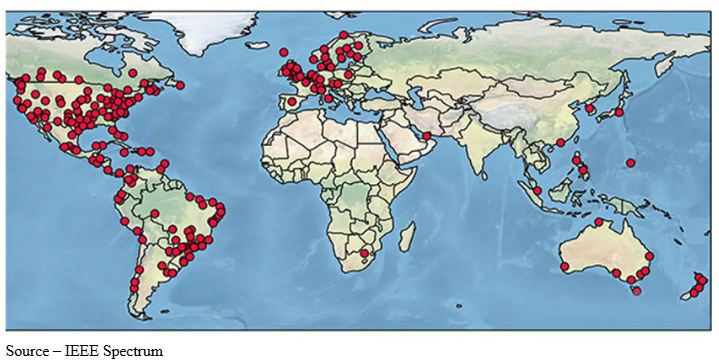
But his team proved they could meet the task by strategically locating content servers around the globe. They also made a series of technology enhancements (adjustments) that made it more efficient and more effective for them to deliver video-over-IP that would automatically adjust to the bandwidth capacity of the subscriber’s internet connection … including their smartphone.
The tech work and rapidly expanding subscription base – now roughly 310M in 190 countries and revenues of more than $10.5B – looked so interesting that everyone jumped into the pick your own show/movie and watch it anytime arena.
They also made more use of their subscriber data to help/advise the content creative team as to what folks were watching and what might encourage them to switch shows or, gawd forbid, switch to a different service.
Admittedly, it took the creative team a little while to warm up to the idea of using algorithms and data to advise folks on the project team what would keep a viewer involved and what might turn them off.
But slowly, they embraced the idea that the data enabled them to do a better job of handling operational and logistical challenges of content production while still giving them greater freedom and resources to create video stories that would resonate locally, regionally and globally.
Things were good because it was great for everyone on the creative team to see their project in the top 10 list week after week after…
Then the fit hit the shan and everything changed!

The pandemic forced everyone to rethink everything, everywhere.
Even though theater ticket sales have been on the downturn since the peak in 2002, the desirability of seeing a movie in the theater with 50-100 strangers just lost its appeal for the majority of folks.
They found it easier, more comfortable and even less expensive to go to the screen of their choice and watch a dynamite movie or show and it quickly became a habit.
Perhaps even more importantly, it forced a seismic shift on how video content was created, produced, posted and delivered.
Almost overnight, the video content industry had to lean heavily into the process they had previously used only occasionally… global production.
Crews, financing, FX, post-production, directors and actors have routinely crossed borders–especially in the Americas where cities, states and “neighbors” have regularly dangled a range of incentives to convince studios, project owners and producers to bring their creative work across the border to New Mexico, Texas, Nevada or Washington as well as across the country to Georgia, New Jersey, Chicago or New York.
Canada, Mexico, Britian, France, Australia, Germany, Saudi Arabia, India, Indonesia–every country–added inducements to streamers for local production beyond their requirement of producing 30-40 percent of the content shown to their citizens.
Global film/show production not only changed because of the pandemic but the “home” location of a project has blurred and it’s never going to go back to the old way of getting work done.
The global film and video arena is expected to reach $328B plus with the movie/show market reaching $112.5B.
Yes, the US film/TV industry is still a leading force with more than 3M folks supporting 240,000 businesses and paying $242B in wages.
But it no longer rules the roost.
Now more than ever, video entertainment production, distribution and enjoyment are global endeavors.
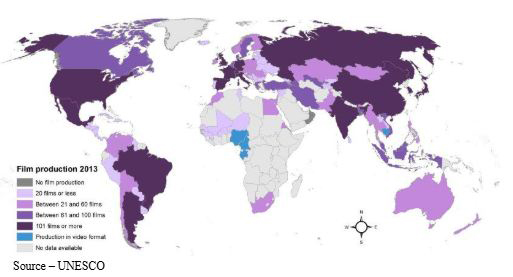
India is clearly the world’s leading film producer and with more than 2,500 projects: and China, which is getting serious about the entertainment race, surpassed both Japan and the US with more than 800 films.
All four have similarly expanded the number of TV series and segments they produce.
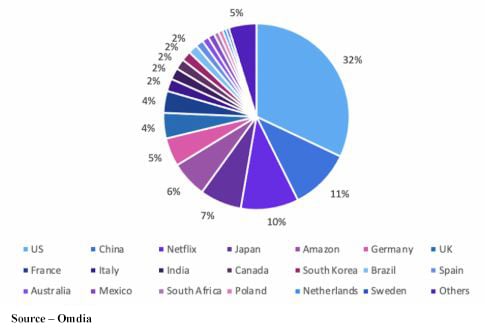
Spain has risen to the number five position but it’s the middle economies that have shown the most significant advance in quality films/shows. These include Canada, South Korea, Mexico, UK, France, Nigeria, Brazil, Argentina, Türquie, Philippines, Iran, Vietnam and Indonesia. Well, let’s just say everyone is getting in on the action.
The ebb and flow of the video entertainment industry is caused by a number of factors:
- Global politics needs to be acknowledged head-on including diplomatic tensions in the world today, country censorship and cultural sensitivities have a decided impact on what is created, produced and shown where.
- Technology is having an unsettling effect on how projects are created/produced, the stability and future of industry jobs as well as the increased ability to reach/influence target audiences with increasing refinement.
- The increased availability of country, regional, local incentives backed by aggressive training programs, virtual production facilities, creative freedom guarantees and added long-term tangible/intangible support.

Films and shows are typically carried out in multiple countries, allowing producers and financial managers to tap into multiple tax incentives, funding sources and distribution outlets, making production work a real work of art that people clamored to see in theaters and at home.
Video content is really an international supply chain rather than a point of origin, production, completion.
American studios have regularly financed, produced and distributed films/shows that are non-American in origin.
The move has only accelerated with global streamers like Netflix, Amazon, BBC and Disney.
Even when the services have committed to creating 30 +/- percent of their content in a country to obtain streaming rights, some or most of the shooting may take in a specific location while pre and post work can be carried out in multiple countries. Film data researcher Stephen Follows noted some time ago that the average top-grossing movies are shot in 1.6 countries while Mission Impossible: Final Reckoning was shot in at least four countries with pre- and post-production carried out in multiple locations.
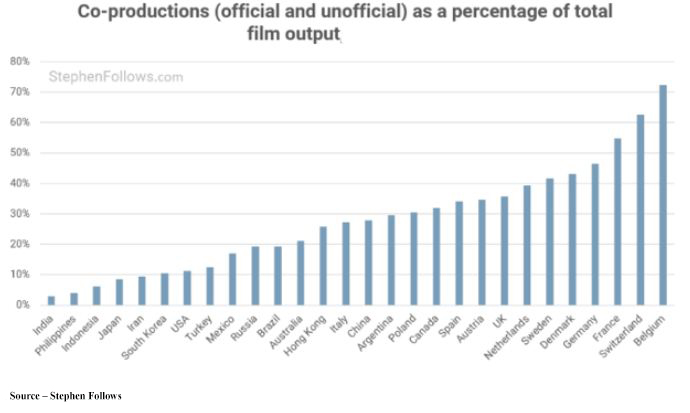
It Depends – There’s no such thing as a film/show made in Hollywood, Atlanta, London, Sydney or anywhere you want to mention because content owners and producers seek out and use the best talent possible regardless of their location. The internet/cloud makes working across borders too easy.
Measuring a film’s/show’s true production footprint is exceedingly difficult.
Some countries provide a few days of aerial production while others deliver exciting landscape, special tax rebates or underwater scenery, digital doubles and virtual production facilities.
Increasingly, many countries have multilateral treaties making it easy to move seamlessly between the locations.
India has become the largest film producing location followed by Nigeria and the Americas.
Bollywood produces more than 1,200 films a year with Nollywood counting an average of nearly 1,000 projects annually followed by the US with 800 plus.
South Korea has steadily increased its film production in the past few years while the UK has seen a reduction of local projects but an increase of projects from the Americas.
The nationality of a film/show is becoming a moot consideration for today’s video content industry; but more importantly, for the viewing public–especially with advanced localization technology which can quickly and economically deliver solid entertainment to viewers in their “language.”
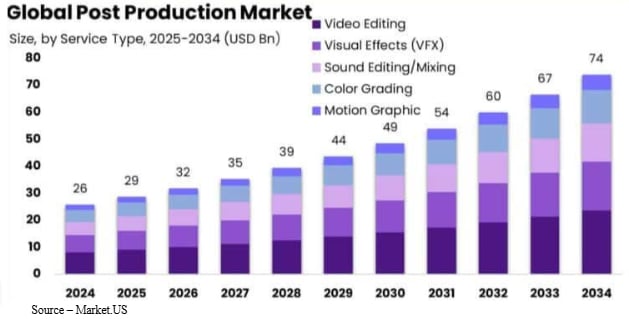
Post Growth – While production advances have enabled producers and cinematographers to make many changes/enhancements on the set, powerful post-production tools and talented folks have increased the value and respect of the postproduction phase of any project.
At the same time, the post-production market has seen a dramatic and steady increase in recent years and is projected to reach nearly $30B this year with a CAGR (compound annual growth rate) of 11 percent over the next ten years.
Post-production is experiencing an increase because of the demand for more digital content by streamers including Netflix, Amazon, Disney and others that rely on a steady flow of original programming and content that delivers a more high-definition, immersive experience.
Automated and machine learning tools developed by organizations such as Adobe and Avid have had a significant impact on the market by streamlining the process with automated editing and scene detection.
The cloud-based tools have enabled real-time collaboration across multiple locations with New Zealand and the Americas becoming the leading go-to locations for the best, most creative and reasonably priced post-production work. But even then, unique specialties/specialists can collaboratively and seamlessly be involved.
The creatives are also expanding and enhancing the use of AR and VR technologies, merging real and virtual elements seamlessly as well as processes including CGI, cloud rendering, real-time color grading, motion graphics and immersive sound mixing.
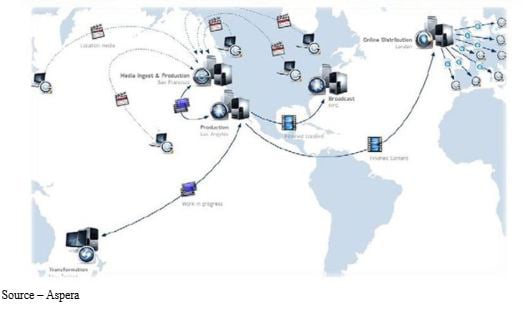
On the Go – Today’s projects are constantly on the move until the final wrap – around the world and around the calendar.
The remote, cloud-based post-production workflow enables original and acquired film/show production to be both infinitely scalable as well as time-sensitive collaboration.
This provides cost-effective workflow for the content creators/owners to economically accelerate project delivery. The pandemic didn’t force the development of virtual production. It just accelerated the industry’s efforts and activity to keep creative content flowing.

It’s an experience no one wants to live/work through again but if you look at how we work today and the quality/variety that is produced today,+ you’ll probably want to repeat what Shane said in Transformers: Age of Extinction when he said, “That was insane! It was awesome, but it was insane!”
If the industry hadn’t creatively gone through the period, we might have had to experience (enjoy?) what Optimus Prime said at the end of the film… “The movies nowadays! Sequels and remakes, a bunch of crap.”
Fortunately, we have a seemingly endless variety of film/show of every genre and type we can imagine from every corner of the world to enjoy on the screen of our choice.
Enjoying the news? Sign up for the Creative COW Newsletter!
Sign up for the Creative COW newsletter and get weekly updates on industry news, forum highlights, jobs, inspirational tutorials, tips, burning questions, and more! Receive bulletins from the largest, longest-running community dedicated to supporting professionals working in film, video, and audio.
Enter your email address, and your first and last name below!


Responses