

City of Charleston Tourism Commercials Shot with URSA Cine 17K 65

Renowned filmmaker Tyler Edwards shot open gate on the camera’s 65mm sensor to capture one of America’s most picturesque cities.
Filmmaker Tyler Edwards recently used Blackmagic URSA Cine 17K 65 digital film camera to shoot a set of commercials and short films aimed at capturing the beauty of Charleston, SC as part of a new tourism campaign by the city.
Edwards was asked to capture the natural beauty of the city’s beaches, ocean fronts and forests, as well as some of the city’s landmarks that have been used by Hollywood filmmakers for more than a century.

He explained: “This project was for a client in the tourism industry here in Charleston. Knowing I had the opportunity to shoot with the URSA Cine 17K 65, I wanted to capture interior and exterior scenes to see how the camera performed in various parts of our beautiful city.”
One of the main reasons Edwards chose the URSA Cine 17K 65 was because it gave him the ability to shoot open gate at 65mm. He noted, “I have been using Blackmagic cameras since the original Cinema Camera 2.5K came out in 2012, so the URSA Cine felt like second nature when I first picked it up.
“Now, what did feel new right away was the massive 65mm sensor, which is much bigger than your typical full frame camera and provides a native 2.2:1 aspect ratio when filming in open gate 17K. This gives a really unique look and really fills out the frame. To me, it felt almost larger than life; like you were there.”
Edwards shot the entire project using the URSA Cine 17K 65, shooting mostly in 24 FPS and occasionally 48 FPS. His first shoot was of a sunset cruise on a small boat, using nothing but natural light.

“With the camera’s sensor, I knew I didn’t need bounce cards or any shaping to manage light. And it worked out great. Normally, I would expect some harsh highlights and some problems with the highlight rolloff from the sunlight hitting skin tones, but there was none. I was really blown away by the dynamic range of the 17K sensor,” he said.
Filming lasted until after the sun went down, which the camera easily handled, capturing details from shadows and low light. “We were kind of running into blue hour and a low light scenario. I noticed that even in low light, I still felt like I could really push the image and everything still looked really clean. Especially since I was going from shooting 17K and converting down to a 4K timeline in editorial and color. The sensor handled low light tremendously as well. Even with a simple grade, there is so much detail all the way from highlights to shadows,” he said.
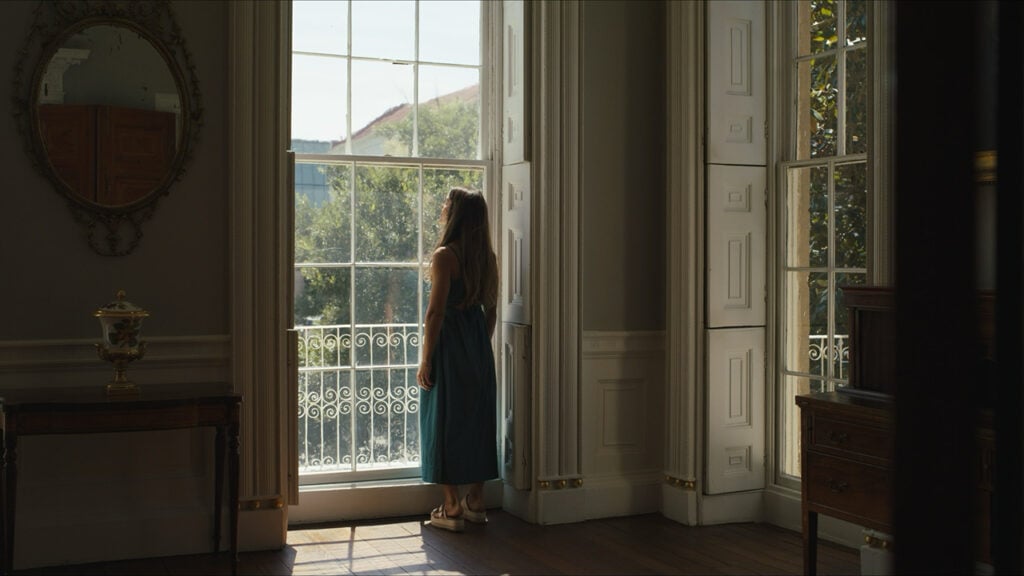
Charleston is renowned for its iconic historical architecture. One of the most unique is the Nathaniel Russell House, a National Historic Landmark where Edwards had to shoot with minimal crew and lighting.

“We had to rely on the strength of the sensor’s dynamic range to handle the mixed lighting coming in from the different windows and the ambient tones inside the house. It worked out better than I expected, and I think my favorite shot of the entire project was where we didn’t use a single light and only had a Dana Dolly pushing in to reveal a door frame and the talent walking towards a window.
“Everything was perfectly exposed, from highlight to shadow. Shooting in this house, the two things that jumped out at me most was just how crazy good the dynamic range was and also how clean the image sensor is, especially in terms of shadows and low light,” he continued.
Edwards concluded: “There’s really no camera out there that has this large of a sensor, that high of resolution and frame rates, at that price point. Not to mention, it’s an RGBW sensor, meaning you can shoot in 17K, 12K, 8K or 4K without cropping in on the sensor. You still get that that super large format look that you get in 17K, but you can save a ton on data and get higher frame rates and a faster readout speed.”
Enjoying the news? Sign up for the Creative COW Newsletter!
Sign up for the Creative COW newsletter and get weekly updates on industry news, forum highlights, jobs, inspirational tutorials, tips, burning questions, and more! Receive bulletins from the largest, longest-running community dedicated to supporting professionals working in film, video, and audio.
Enter your email address, and your first and last name below!


Responses