


California, Hollywood at a Crossroads

“I’m doing everything alone. Crossing roads alone. Seeing the Eiffel Tower alone. Fighting muggers alone. – Rani, “Queen“, Phantom Films
We’ve been thinking about the state of the M&E industry quite a bit lately and more importantly, the roles California and Hollywood will play in its growth and prosperity.
We’ve lived in California nearly all of our adult life, working on the technology underpinnings of the industry nearly all this time and closely involved at all levels with folks who bring story ideas to life.
Yes, there are a lot of things about the state that makes it a prime industry location – great vibes, Mediterranean climate, outdoor lifestyle, and a fantastic diverse culture.

Then there’s Hollywood, a place that was built on making the industry feel grand, historical and extremely important.
Movies like La La Land, a tale about chasing the beauty of art and falling in love under the California sun or Once Upon a Time in Hollywood that turned history into a marvelous fairytale.
Look behind the storylines and it’s expensive to live here – seriously expensive – taxes are high and there are a myriad of regulations – state, county, local – that make things difficult to get stuff done–especially for the industry that has the creative ability to make anyplace look like somewhere else.
We were thinking about this and the cockfight posturing between WarnerMount and legislative groups at all levels.
Early on, David Ellison, as the merger worked itself through governmental approvals around the globe emphasized his commitment to the company’s hometown saying, “I believe in Hollywood, I believe in the future of Hollywood, my future is here.”

The merger has signoffs from governments around the globe. Well everywhere but California. The state’s attorney general, Ron Bonta, and area officials claim Ellison has suddenly made a flip-flop and would move his company out of California, insinuating it was a hollow threat.
But is it?
The state already has the unenviable business reputation of ABC (Anywhere but California) which has been one of the reasons more than eight of the Fortune 500 companies including Chevron, Charles Schwab, Tesla, Yamaha Motors and Ellison’s father’s company Oracle to relocate their headquarters out of state.
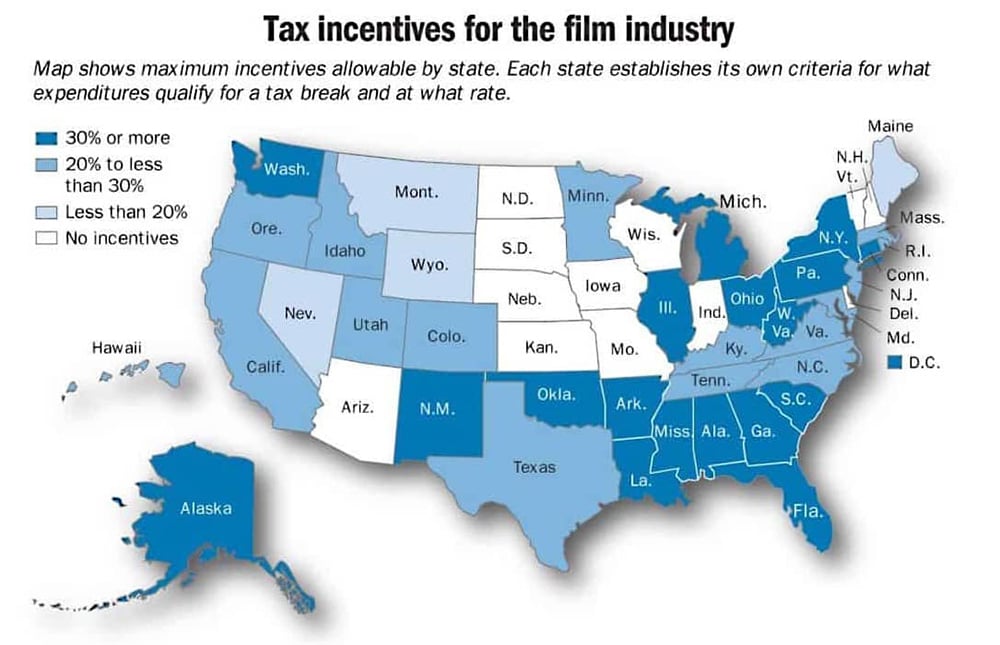
There are already 38 states that are eager to attract film and show work to their state and the other 12 could probably cook something up to make it inviting for a big industry fish like WarnerMount to be landed.
And if not the whole enchilada, at least a few projects.
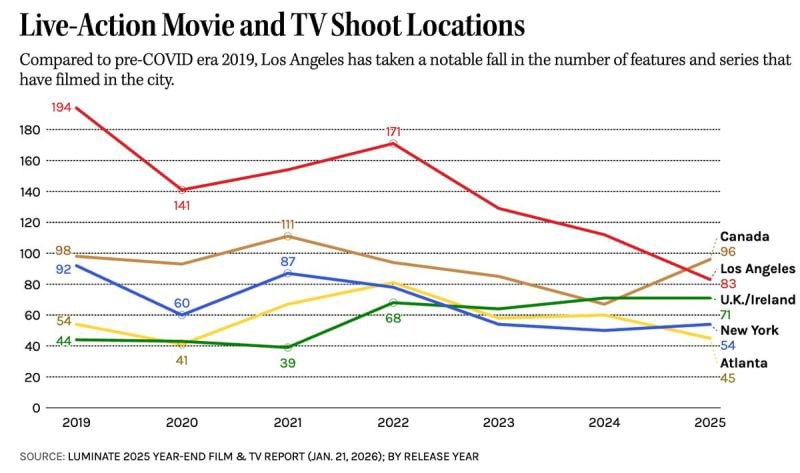
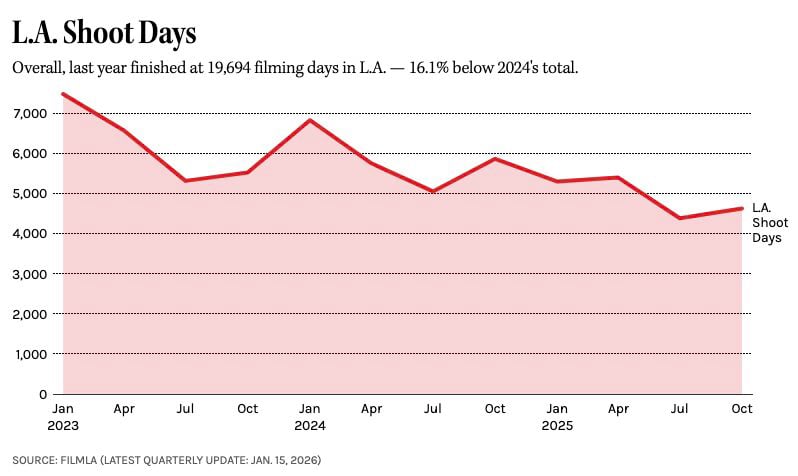
Part of his objection to the Warner/Paramount merger is that it will result in the loss of businesses and jobs in the state. But that’s been going on for years.
There is a massive network of businesses, organizations and people who are needed to help turn movie, show and commercial production ideas into fantastic shows/movies/stuff people watch.
Camera/lighting houses; prop/wardrobe houses; stages/studios; caterers/security services and hundreds of more have felt the brutal impact of films/shows moving elsewhere in the country and beyond.
And that doesn’t even include the thousands of stunt, safety, background actors, writers, tradecraft persons, and others who chase every whisper of a project that might last a week, a month or if they’re lucky, three-six months.
Yes, it’s been a tough couple of years for people in one of the toughest, most competitive industries in the world that chases the illusive likes/dislikes of people around the globe.
And it’s being done in the most challenging, expensive parts of the US.While there are 10s of thousands of sq ft of vacant studio spaces in the LA area, organizations like Netflix, Lionsgate, Amazon, and others are building new, large, state-of-the art facilities in New York, New Jersey, New Mexico, Texas, Georgia, Louisiana and other states.
All of these states and local governments have offered a wide range of tax credits, cash rebates, incentives, grants, sales tax waivers, free locations and most of all, they minimize/streamline paperwork requirements.
They make the teams know they are welcome and appreciated because they bring work for locals and income to the state/local economy.
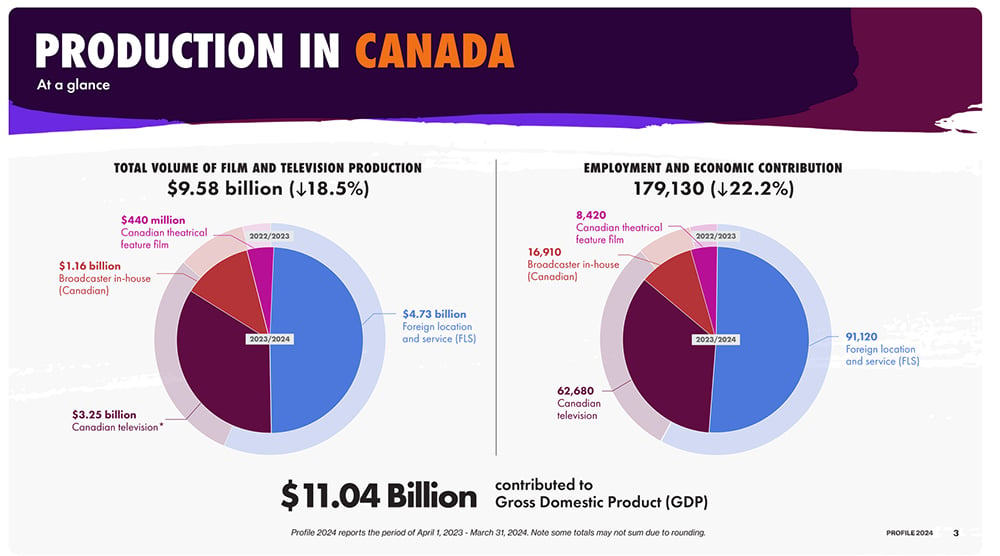
The (relatively) weak Canadian dollar, close proximity, common language, extensive production facilities, highly trained/skilled professional folks and incentives have made Canada one of the most cost-effective film/show production centers for US -based film and streaming projects.
Vancouver, Toronto and Montreal offer mind-blowing digital and physical production facilities as well as teams of experienced local crews to handle a broad range of creative requirements.
Their FX activities are among the finest…anywhere.
Tax credits are available from federal, provincial and local jurisdictions as well as stacking guidance to optimize financial production assistance.In conjunction with countries professional organizations, the federal and provincial governments continually carry out basic education through advanced education programs for people in all areas of film/show development, production and post technologies.
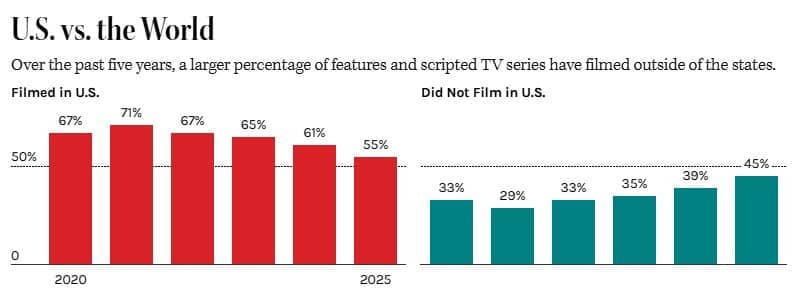
Hollywood doesn’t just compete for film/show production budgets with other states and Canada, but increasingly around the world.
Almost every country around the globe has leveled the playing field as they bid for production budgets which are projected to reach $297B this year and $384B by 2030.
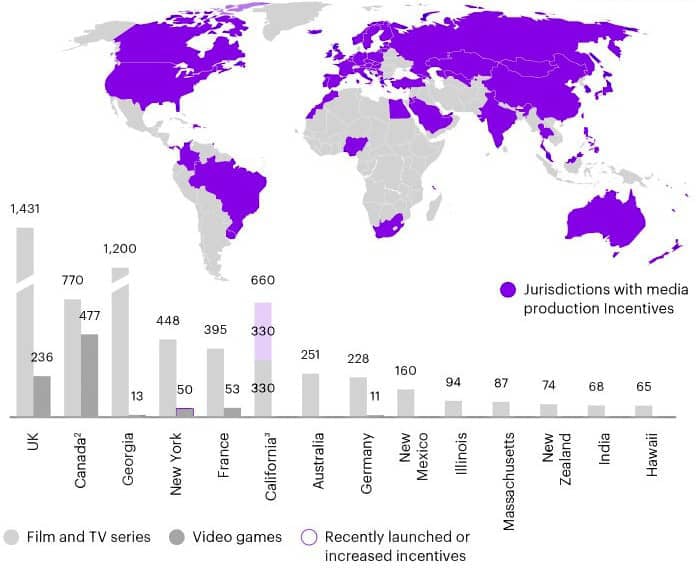
Federal governments, states/provinces and cities/communities have steadily built out state-of-the-art studios and production facilities to attract content production to their areas.
In addition, they have invested in developing the support activities the projects required including all areas such as transportation, catering, on-set production work, postproduction, safety/security, and just about any talent/expertise that might be needed to complete a project quickly, efficiently and effectively.
At the same time, country governments as well as area and local jurisdictions have developed financial incentive programs to “interest” project accountants and convince producers, directors, location managers and investors.
And…it works.
The UK’s AVEC (audio-visual expenditure credit) offers 25-40 percent on spending for above- and below-the-line costs.
Ireland has a 32 percent base that increases to 40 percent for indie projects and even 20 percent for unscripted shows.

Even the EU agreed to major co-production agreement that supports indie producers from different countries to work together across borders.
Australia offers 30 percent with no annual cap which has contributed to interest a growing number of international projects.
MENA countries have been increasingly aggressive/creative in developing their studio/production infrastructure, including advanced sound/production facilities as well as added crew/support team financial incentives. and skill training to meet the needs of film/show projects.
Saudi Arabia provides rebates of up to 60 percent for film, documentary, animation and TV series expenditures as well as a myriad of cash-flow processing activities.
Jordan and Abu Dhabi offered tiered rebates of up to 45 percent as well as 24-hour customs clearance for gear and work visas and expedited local production clearances.
In fact, there are about 120 film/show incentive production programs worldwide in addition to 40 similar state programs in the US to develop global competition for film/show projects and jobs.
The only country that doesn’t have a national program is the US (go figure).
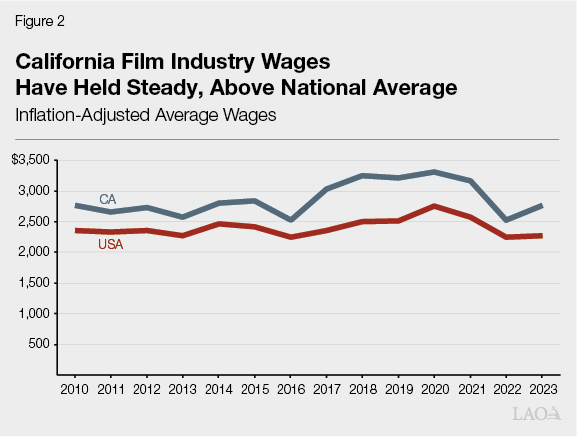
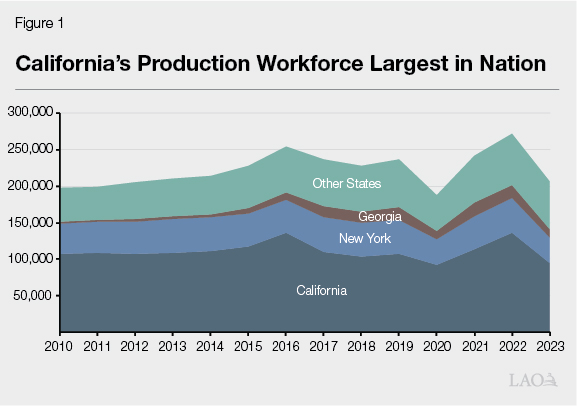
To its credit, California has “refreshed” its incentive programs to be more price competitive with locations around the US, Canada and world despite the high labor costs and aging infrastructure.
The one unique thing that arguably sets California apart from and above many other national and international production locations is a highly skilled/seasoned content creation/production workforce and experienced support industry.And for many folks, the luxury of being able to go home at night after a tough day on the set or in the post facility is “almost” priceless.
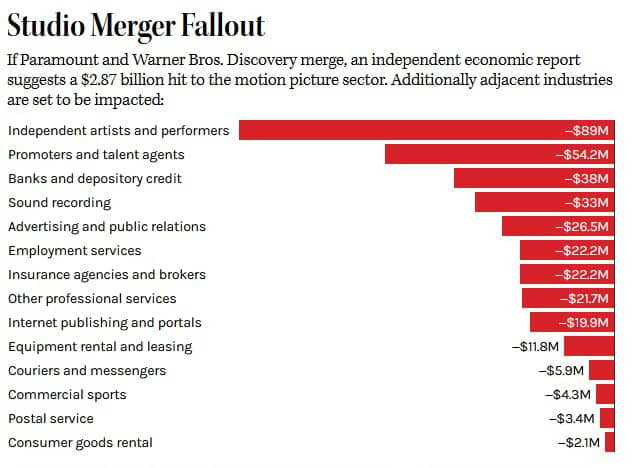
We suppose it was around this one fact that the LA County issued its economic report supporting Attorney General Botta’s reluctance to approve the Paramount/Warner merger suggesting that the combination of the two organizations would result in a $2.78B impact on the local film/show production industry.
Taken on its own merits, the report presents a very compelling case, especially as the industry celebrates the success of major blockbusters and people returning to put their seats in theater seats.
In addition, streamers need an endless supply of films/shows for their libraries.
Christoper Nolan’s The Odyssey (with a budget of $250M ++) became the highest-grossing R-rated movie with ticket sales of $1,36B worldwide. However, the film was produced/filmed in Morocco, Greece, Italy, Iceland, Scotland and Malta with a minor portion of the work done in Universal Studios.
Spider-Man: Brand New Day (budget of $225M +) gross surpassed $2B but was produced primarily in the UK.
Other high-grossing projects that the industry celebrates include:
- Dune: Part Three – budgeted at $200M is predicted to gross up to $1B and was produced in Hungary, Jordan, Abu Dhabi, United Arab Emeritus
- Star Wars: Episode VII – with a budget of $536M, grossed more than $2B and was produced in England, Abu Dhabi, Iceland, Ireland
- Superman: No Way Home – budgeted at $200M racked up nearly $2B in worldwide ticket sales and was produced in Georgia, New York, Iceland
- Deadpool & Wolverine and Beauty & The Beast – with budgets of $534M + and $255M+ respectively, earned about $1.4B and ultimately $1.3B worldwide and both were produced in England
In other words, even as David Ellison has publicly committed to creating and delivering at least 30 films annually, there is no guarantee that the projects will be created in Hollywood based on industry trends and film industry’s accounting guidance.Those financial/final decisions are above our – and probably your – pay grade.
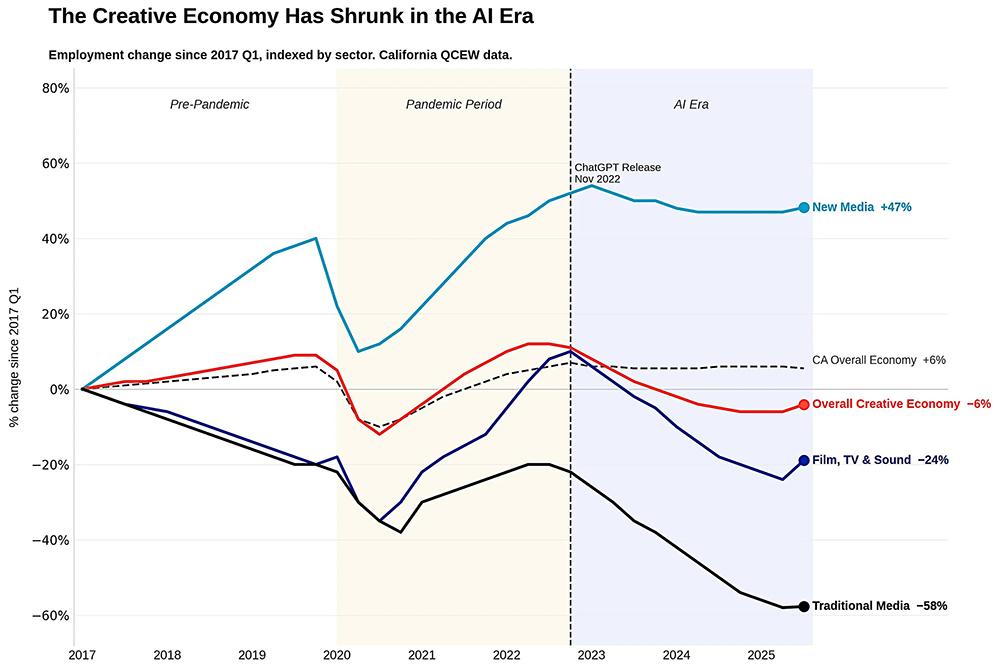
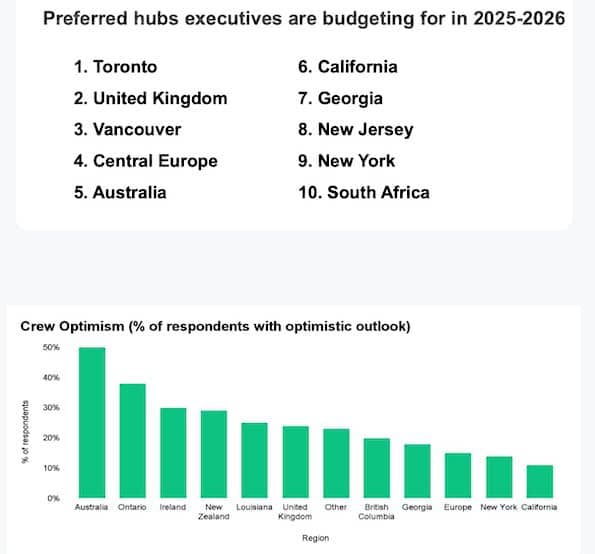
Films and shows will continue to be developed, written, shot, produced and posted in Hollywood.
And while state and local jurisdictions work to clean up and make competitive development programs to entice “mainstay” film/show projects to stay close to home, the industry should begin understanding and embracing the rapid growth new media shorts, mini-dramas and indie films that still see Hollywood as the creative center of the M&E industry.
They have different wants/needs, but the creative talents and support requirements are the same or similar.
At the same time, the Hollywood industry could/should consider the merger in a more positive/realistic manner.
Sure, there will undoubtedly be layoffs and “a little” chaos for at least a year but consider four major questions beyond state government ego:
- How can every other international jurisdiction think it’s the best solution for a renowned/highly respected global entertainment company to survive and thrive while state officials say they see something devastating behind the move?
- If the merger is rejected, what happens to what is left of WBD? A very legitimate bidder (Netflix) was “rejected.” Do we reappoint Zas to rebuild the organization he was paid very, very well for four years of tearing it down – firing staff and gutting/realigning the organization – and putting it in today’s weakened/uncertain position and clouded future?
- Do we encourage/push Paramount toward the exit as the state has done with so many Fortune 500 firms in the past by continuing to be adversarial to businesses that provide taxes and jobs to people who really appreciate California for what it has to offer for folks? Or do state/local officials focus on those things governmental agencies can/should change/fix that expand business opportunities/jobs that ensure the state will continue to be the sixth largest economy in the world and the heart/soul of the global movie/show industry?
- Are jobs going to be lost? Yes, probably because there will be duplications but certainly not in the content creation/production fields where people will be developing/producing/delivering shows/movies for audiences around the world. The key is that WBD and Paramount aren’t just competing in an isolated country but in the global entertainment arena. And to continue to do it successfully it needs the support of national, state and local governments similar to those provided in other countries which means training and state of the art production facilities, tools and staff/trade pro support.
One merger – or breakup – won’t solve the issues facing the Hollywood entertainment industry which doesn’t just compete for projects that are being shot/produced in New Jersey or Dallas but also the facility/team/support offerings by Toronto, England, Germany, Spain, Brazil, Australia and hundreds of locations around the globe eager to become the new Hollywood. Sure, it would be great if we had a national government that felt the entertainment industry was as important to a country’s growth and stature as do other countries elected officials but since that’s not possible in today’s environment, the state will have to “fill the gap” and work with rather than against the world’s most creative studios/streamers…anywhere.

Or as Vijayalaksmi said in Queen, “Why fart and waste it when you can burp and taste it!”
Okay, he wasn’t subtle, but you get the point.
The Hollywood creative industry needs to again taste the success it enjoyed years ago when it and creative people at all levels experienced the thrill (and financial rewards) of meeting the entertainment needs of folks around the globe.
We’ve interrupted production twice in recent years – pandemic, strikes – theaters need films to fill their release date calendars, networks (yes, they’re still greenlighting shows) and streamers need new library inventory.

Consolidation may not be the best answer but that was caused by a very, very, very well-paid executive team, not Paramount.
And a very carefully thought-out joint industry-wide regulatory/refreshed industry support program should probably be considered in light of today’s global entertainment creation, production, and post world.
But needless delays just put a lot of much-needed project investment and jobs in uncertain limbo.
People, highly skilled/professional people, don’t deserve that!
Then state/local officials can call on the Hollywood accounting teams to solve really tough problems like the state’s homeless crisis and 405 traffic.
Yeah the way these dudes/dudettes work they can make a couple of million do the work of 10s of millions so these “little” tasks should be a snap.
Enjoying the news? Sign up for the Creative COW Newsletter!
Sign up for the Creative COW newsletter and get weekly updates on industry news, forum highlights, jobs, inspirational tutorials, tips, burning questions, and more! Receive bulletins from the largest, longest-running community dedicated to supporting professionals working in film, video, and audio.
Enter your email address, and your first and last name below!


Responses