

The Impact of AI on the Contemporary Process of Film and Advertising Post-Production

A New Creative Environment: From Analog Craft to Digital Collaboration with Algorithms
Just a decade ago, film post-production required teams of specialists-editors, colorists, graphic designers, and VFX operators. Today, many of these processes can be handled by a single person supported by AI-driven systems.
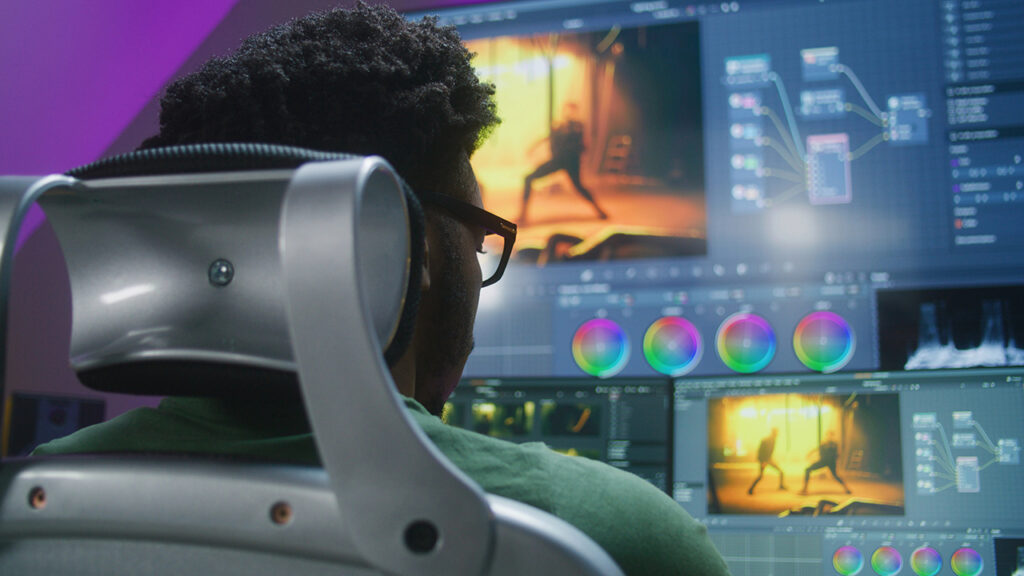
Tools like DaVinci Resolve Neural Engine, Adobe Sensei, and Runway Gen-2 analyze footage in real time, learn the user’s style, and even predict editing decisions. AI can separate foreground and background, create masks, enhance exposure, and reconstruct missing frames.

Professionally, this shift is comparable to the transition from linear to digital editing—transforming not only technology but also mindset. The creator becomes a collaborator with the algorithm.
Practical Applications: When AI Truly Helps
The benefits of AI in post-production are most visible in three key areas:
Restoration and Upscaling – Tools such as Topaz Video AI or DaVinci Super Scale refresh archival materials and upgrade them to 4K or 8K without losing detail. In documentary filmmaking, this enables the reuse of decades-old footage.
Denoising and Image Cleaning – AI algorithms reduce noise and enhance contrast while preserving natural skin and fabric textures. This is crucial in beauty and fashion advertising, where visual precision defines aesthetic impact.
Tracking and Rotoscoping – Tasks that once took hours in After Effects can now be done in minutes with Mocha Pro or Roto Brush 3.0.
The result? The creator regains time to focus on emotion and rhythm rather than purely technical correction.
The Human in the Loop: Why Creative Control Still Matters
AI can process an image faster than any human-but it doesn’t understand meaning. In film production, the concept of the “human in the loop” has become essential: the person remains at the center of the decision-making process.
An algorithm may balance lighting, but it cannot determine whether a scene requires emotional intimacy or cold detachment. The ability to interpret errors-to know where the machine’s help ends and creative choice begins-has become a vital skill.
Thus, editors and cinematographers are no longer only operators; they are directors of the machine learning process, guiding algorithms toward artistic and narrative coherence.
Emerging Roles and Skills in the Audiovisual Industry
AI-driven post-production demands new kinds of professionals. Major studios in Los Angeles, Toronto, and London already employ AI Post Supervisors-specialists overseeing human–algorithm interaction.
These roles require more than software knowledge. They involve understanding machine learning structures, diagnosing prediction errors, and merging technological expertise with artistic sensitivity.
This confirms a fundamental truth: in the age of automation, creativity doesn’t disappear-it evolves. Artistry now lies in designing the relationship between human intuition and computational intelligence.
Data Ethics and Responsibility for the Image
AI development raises a crucial question: what data trains the algorithms that process our images? In the creative industry, every pixel can be subject to copyright.
Companies like Topaz Labs and Adobe now emphasize that their models are trained on licensed, closed datasets. For professionals, this is not a minor detail but a matter of legal safety. Footage processed by AI must retain its intellectual property status—both in feature films and commercial projects.
Ethical awareness thus becomes an integral part of creative craftsmanship, just like composition or lighting.
The Craft of the Future
Artificial Intelligence is not the end of filmmaking-it’s the beginning of a new creative era. It shifts the focus from manual execution to conscious direction. The video creator becomes a designer of visual experiences-someone who understands emotion and translates it into a technically refined image, supported by algorithms.
This is the redefinition of craft: a fusion of technical, mathematical, and aesthetic intelligence.
In a world where images are generated faster than ever before, intuition remains the artist’s most valuable tool.
Enjoying the news? Sign up for the Creative COW Newsletter!
Sign up for the Creative COW newsletter and get weekly updates on industry news, forum highlights, jobs, inspirational tutorials, tips, burning questions, and more! Receive bulletins from the largest, longest-running community dedicated to supporting professionals working in film, video, and audio.
Enter your email address, and your first and last name below!


Responses