

Recordia Delivers Podcast Production Workflow with Blackmagic Design

From podcast formats to training, standardized rooms and control room workflows keep quality consistent across every session.
When Roch du Boys and Yanis Rabehi decided to scale their video production expertise into a dedicated podcast studio operation, they knew the audio and video infrastructure had to match their ambition. After a decade in video production and five years training clients in digital marketing, the duo had seen the same pattern repeatedly: 90 percent of their clients eventually needed some form of video content.
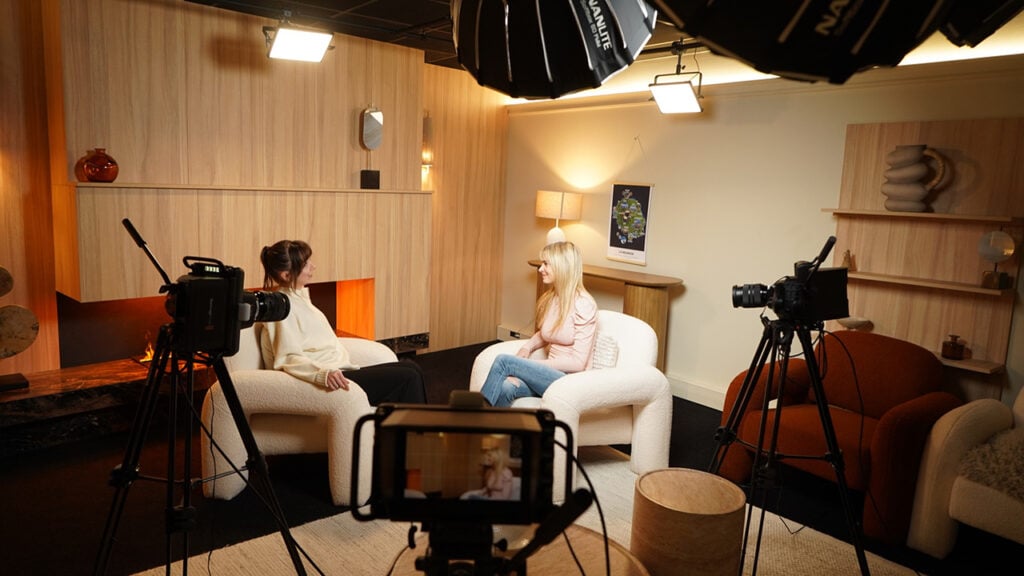
That insight became Recordia, a facility with four studios in Nice, France built in partnership with Greenbull Group. The company’s leitmotif focuses on what du Boys calls a “premium standard” production, featuring identical setups across rooms, designed to produce the highest quality output.
“We are more expensive than competitors and we know it,” du Boys explained. “But clients see the investment in technology when they walk in and they understand they’re getting cinema quality production for their podcast or training content.”
Studio cameras for a connected control room
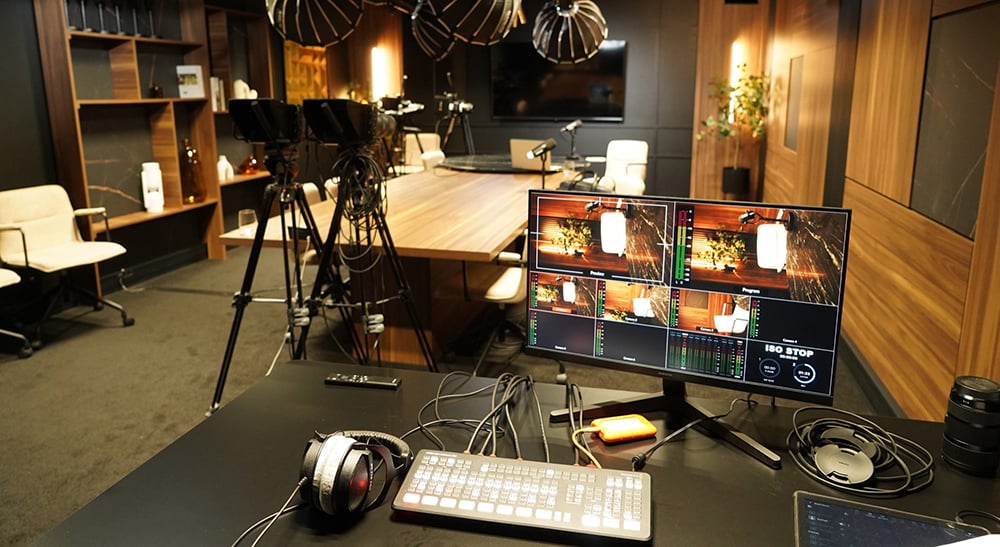
Reflecting his background in traditional production, du Boys initially planned to equip Recordia with full frame cameras. But as the spaces took shape, it became clear that a dedicated studio camera system, tightly integrated with the ATEM Mini Extreme ISO live production switchers, would better support the level of consistency and throughput he was aiming for.
“Greenbull’s technical team pushed us to look seriously at Blackmagic Design, especially because of the integration it afforded,” du Boys recalled. “Two things immediately stood out. The ATEM Mini Extreme ISO’s support for camera control, and the XLR inputs that let us run separate audio tracks.”
The audio requirement was non negotiable. Rather than relying on an external mixer delivering a single master output, the norm in many podcast studios, du Boys wanted isolated audio per contributor for more flexibility in post. With up to four people around a table, separate audio tracks per camera was essential.
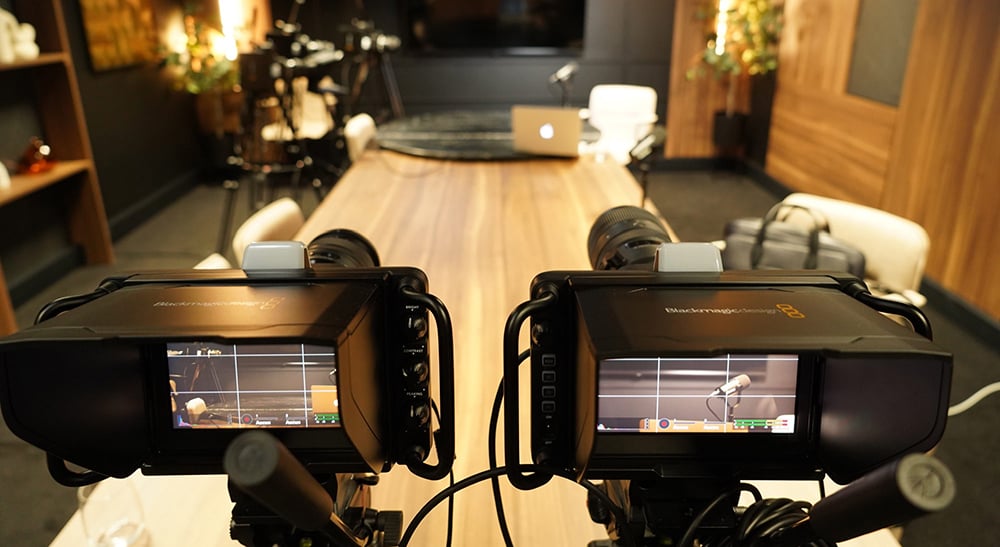
Working with Greenbull, du Boys finalized a configuration built on the Blackmagic Studio Camera 4K Pro G2 paired with Metabones Speed Booster adapters and Sigma zoom lenses. The Speed Booster helped to reduce the sensor’s crop factor while also adding an additional stop of light.
Scaling a multi studio workflow
Recordia currently uses 20 Blackmagic Studio Camera 4K Pro G2s across four distinct studio environments. The two smallest spaces use four cameras each, enough for individual coverage plus a master shot. A third space, nicknamed the “Cozy Cream” for its fireplace and armchair aesthetic, runs five cameras while the largest studio accommodates up to ten people with seven camera positions.
Each studio operates independently with its own ATEM Mini Extreme ISO, chosen for its ability to record separate ISO files from every input and a DaVinci Resolve Studio project file.
Lighting setups remain permanently rigged, with backlights and key lights controlled remotely via a tablet from each control room. Camera positions are pre marked for both horizontal and vertical orientations. “We can get a client ready to record in ten minutes,” du Boys noted.
Every session begins in Recordia’s reception area with a short briefing. The team discusses the project, intended audience and distribution plans, and whether clients need postproduction support.
“We provide two tiers of service. Option one is that clients gain access to the studio’s technical capabilities alongside some initial coaching, and then record independently. Alternatively, clients can have an operator present throughout, plus real time rough cuts delivered as structured file packages.”
Recordia groups its work into three main scenarios, each using the technical and studio infrastructure in a slightly different way. The facility also supports live streaming productions, with the ATEM switchers enabling real time broadcast for corporate events and webinars alongside traditional recording workflows.
For traditional podcasting, the team maintains a minimal level of interaction once cameras are rolling. “In the control room, an operator monitors multicam feeds while adding annotations, and timecodes mark compelling moments for potential intro clips,” du Boys explained. “Technical issues get flagged and operators note when subjects mention specific topics that might benefit from graphics. The goal is that our client’s editor never has to watch the entire recording.”
Content creator sessions require more active direction. When clients shoot short form vertical formats, Recordia’s team challenges every take on copywriting, delivery and physical presence. The multicam setup captures performance from different angles simultaneously, while preplanned tripod positioning allows instant switches between horizontal and vertical formats without having to reset.
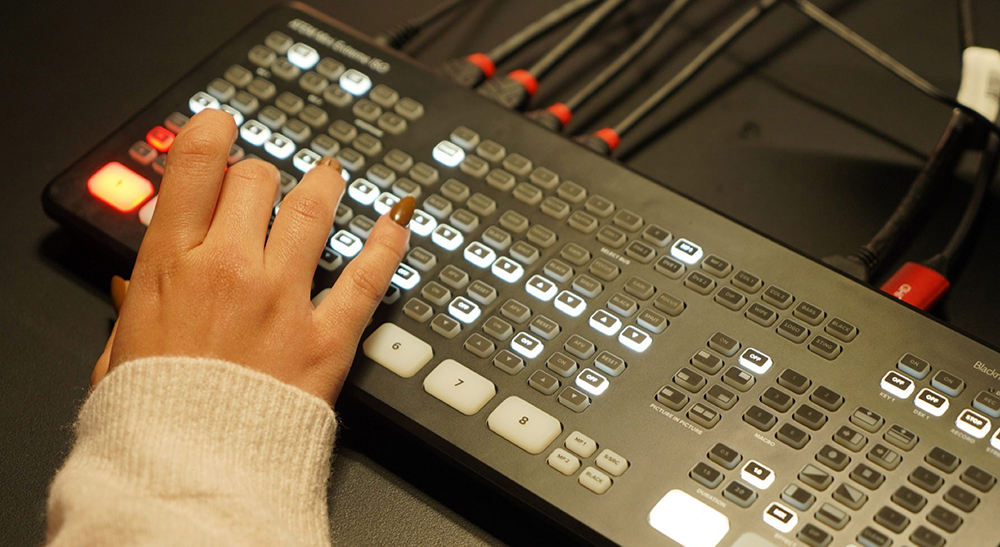
Training content represents Recordia’s most technically complex workflow. Clients regularly book multiple sessions lasting six to seven hour to capture 20 hour courses. For these sessions, an operator uses macros to create a rough cut assembly on the ATEM Mini Extreme ISO, automating the switching of camera angles and integrating instructor’s slides via HDMI with picture in picture layouts, and any relevant notes.
Rapid turnaround for clients
Postproduction leverages the ISO recordings and metadata generated by the ATEM Mini Extreme ISO during capture. Timecoded annotations, pre marked edit points, and organized multicam files enable rapid turnaround. “We delivered a training course lasting 20 hours as a fully edited program four days after the shoot,” he noted.
Rapid expansion has left some items on the technical to do list, according to du Boys. “We have plans to expand audio processing, including dynamics processing and high pass filtering directly into the ATEM output chain,” he noted. “We are also working to develop custom LUTs tuned to our unique lighting and interior design.”
Recordia’s core infrastructure fulfills its promise of premium production quality through standardized, repeatable workflows. The Blackmagic Design ecosystem provides the technical foundation that makes this all possible.
“We have spent years doing custom video production where every project was different,” du Boys concluded. “With Recordia, and our implementation of Blackmagic, we have found a way to industrialize premium quality, delivering our clients cinema level results on podcast timelines.”
Enjoying the news? Sign up for the Creative COW Newsletter!
Sign up for the Creative COW newsletter and get weekly updates on industry news, forum highlights, jobs, inspirational tutorials, tips, burning questions, and more! Receive bulletins from the largest, longest-running community dedicated to supporting professionals working in film, video, and audio.
Enter your email address, and your first and last name below!

Responses