


Multi-Generational Team Can Aid Growth

“But you don’t know. You just assume. One for one. What everyone’s been taught to believe. One for one.” – Logan, “Logan’s Run,” MGM, 1976
The hiatus from the office didn’t cause the global shortage of new, middle managers and senior team employees, it only exasperated and shined a spotlight on the situation which has been years in the making.
While the world wrestled with the pandemic and recovery, some businesses explored and attempted learned new ways of moving forward to keep national and global economies on track and prepare for a new/different normal–especially in the M&E industry.
Others simply picked up where they left off assuming employees would pick up where they left off.
The slight pause also enabled a few companies and countries to confront the multitude of climate challenges and potential solutions.
Others blindly ignored the inevitable.

At the same time, governments and firms are being forced to come to grips with longer-term challenges – an available/interested workforce and an aging population.
Perhaps more importantly, people – especially Gen Zs and Millennials – have had time to reconsider their work-life balance and their career paths.
Following the recessions of the 1980s and 2008 as well as the 2020 downturn; the global population didn’t simply become static; it began to shrink and at the same time people were living longer.
The world economies have come under significant strain.
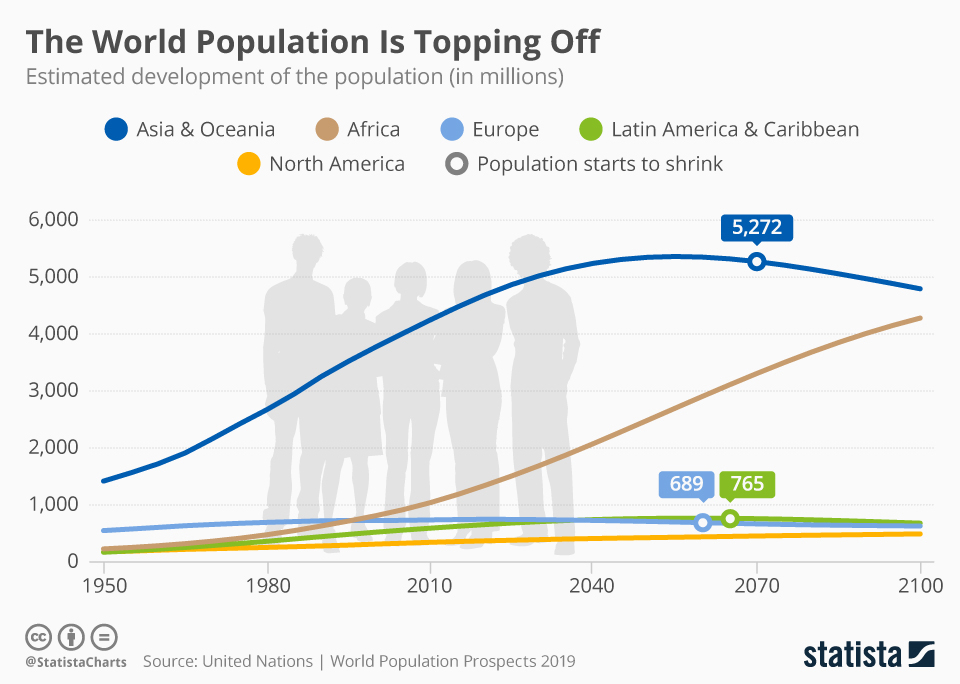
Ups, Downs – For years people, especially people in the film industry, forecast a time when the Earth would be overpopulated leading to all kinds of disasters and “issues.” Problems still remain but overpopulation isn’t one of them.
Economists view Japan as the canary in the coal mine.
While its birth rate isn’t as low as many other rich countries, it has been low for a longer period.
With the population declining back to the level of two decades ago, Japan has shown that a shrinking population doesn’t necessarily and automatically impoverish a country.
Even as productivity grows and women enter the workforce, Japan’s per capita income has increased while the country approaches deflation.
However, each year the country’s dwindling pool of “working age” people (Millennials), must support an expanding pool sidelined experience/expertise and grey-haired consumers.
With a long history of promoting individuals based on seniority, companies are depriving themselves of fresh-thinking younger people, staying closed to new ideas and remaining rigid in their structure and direction.
To offset the shrinking and aging population, Japan has accelerated its efforts to become a leader in robotics and automation. This helps a little, but robotics and automation don’t buy stuff, and consumption is the bedrock of the global economy.
At the other end of the spectrum, China initially worried about the dangers of over population and set a limit of one child (preferably male) per household in the late 1970s.
It worked – too well.
To reduce the population shrinkage, a two- to three-child policy was promoted but younger Chinese men/women haven’t responded.
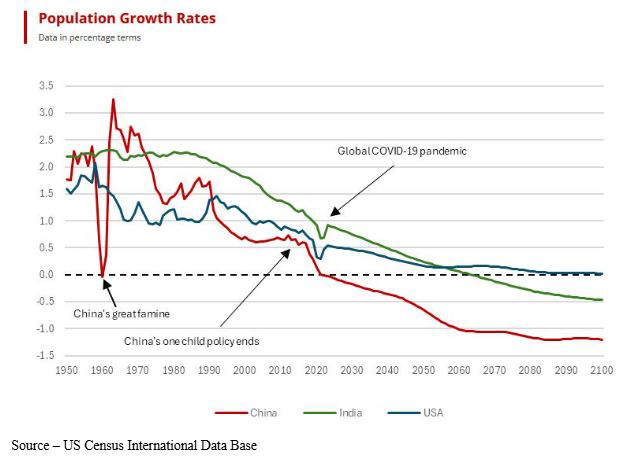
Mother Nature – When governments try to mess with Mother Nature (like limiting childbirth), it can have unforeseen consequences as China found out with its one child rule.
While the government trumpeted the change to stimulate growth … folks aren’t buying into it!
Women worry that it will only increase management’s subtle – and not so subtle – discrimination to avoid pregnancy’s work disruption, the added paternal/maternal leave costs and disrupt their newly found freedom.
Chinese folks – and young couples in nearly every country – say they are already hard pressed to find the right position and take care of themselves, let alone children.
To counter the negative growth in the US someone “brilliantly” suggested a $5,000 bonus for having a child.
Really!
The personal and financial burden is more than many want to undertake in either country.

Their Struggle –Women in China and around the globe have elected to take their futures into their own hands, including working and childbirth.
A leading Chinese feminist/activist noted that her government is very good at empty talk, and the lack of social concern and support discourages families from having children.
In case it sounds familiar where you live, she noted that because of governments/firms ignoring the obvious, younger people are simply not interested in having more children and in fact, better educated women prefer to possibly have small families … later.
Of course, that’s “over there” and certainly doesn’t affect your organization or where you do business–right!
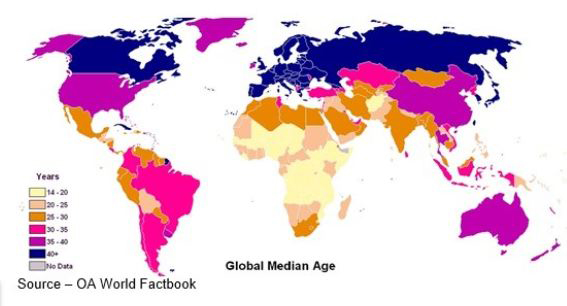
Median Age – The marketing sweet spot may be the Gen Z and early Millennial populations, but these are far from the largest population segments and the trends will continue.
Since 1950, the global population has increased 1-2 percent each year and will likely peak by 2064 to about 9.7B – and then decline to about 8.8B by 2100.
An estimated 22 percent of the world will be over the age of 60 — more than 400M people – by 2050.
In addition, 183 countries will have a total fertility rate lower than the replacement level.
Your Business Option?
Yes, we know what techies say … AI will solve the problem.
BS!

Perhaps it’s time for more enlightened business and personnel policies since there isn’t a helluva lot your organization can do about reversing the population trends unless you’re Elon Musk and want to solve the problem all by yourself … 13 and counting.
Organizations that made it through the pandemic now have a major new and even more pressing problem according to Prudential’s Pulse of the American Worker Survey: more than a quarter of their employees will leave.
However, just as organizations struggle to emerge from the current downturn and prepare for growth, firms are facing a dearth of available young employees who have different priorities for themselves than in the past.
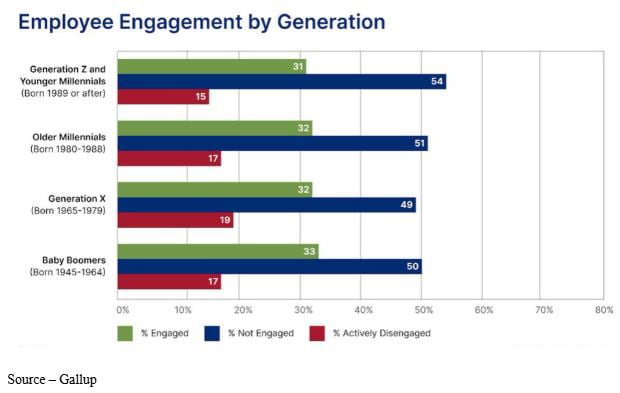
Workforce Adjustment – Even with the pandemic well behind us, companies expected a rush back to work, which hasn’t happened. Fewer young employees are fully engaged with their employer and the firm’s success. This results in decreased productivity, lack of initiative and disinterest in professional development. Employers suddenly have to look for new inducements to get the employees they want/need beyond simply salary.
Younger adults are staying out of the labor force longer and the trend is expected to continue even as the economy struggles to recover…and beyond.
In addition, these men and women have had the time to ask themselves, “What, they simply left?”
What do they really want to do?
Do they want shorter hours, more free time for family/hobbies or that the office they return to is not the one they remember leaving awhile back?
With the economy simultaneously reopening and slowing, many employees and would-be workers are simply not ready to come back to the environment they left and perhaps even to the workforce.
At the same time, older adults are staying in the labor force longer and it’s nothing new.
Government estimates show that 93 percent of the U.S. labor force between 2006 and 2022 were workers who were 55 and older.
The 79M Baby Boomer generation represents 26 percent of the total US population and they are redefining old age in the Americas and in other countries the numbers are very similar.

Old is New – The youth of the 1980s had a whole list of country and global problems they wanted solved NOW!and heroes on the big screen. As we say, “They’re back!”.
They made their mark on teen culture, young adult life and middle age.
Even Top Gun: Maverick’s star Tom Cruise is 62!
They put the E in ecommerce, launched the first ISP (internet service provider), introduced the iPhone, created the Web and its global connectivity; and yes, created some of finest movies and TV shows that are the foundation of today’s creative work.
Typically, they don’t believe – or feel – that old age begins until the mid-late 60s. The typical Boomer approaching the arbitrary end of their working years are strongly considering (6 out of 10) postponing retirement.
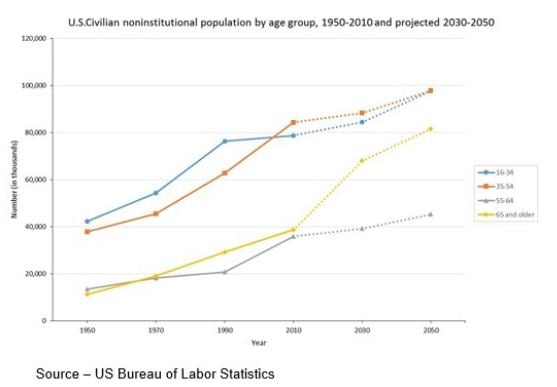
Aging – Surprise, people get older over time but increasingly, age is just a number and with many people that number is unlisted. They intend to stay productive.
In fact, today’s older workforce is growing more rapidly than the younger workforce.
Population growth for folks between ages 20 and 64 actually turned negative last year.
Research shows that an age-diverse workforce has a positive effect on employee engagement, productivity and an organization’s bottom line.
Still, older workers face resistance more often – especially if they are female and/or non-white – because they are perceived to be “too old,””too set in their ways” or “not a good fit” for the job–particularly in the creative and tech industries.
Management is slowly coming to grips with the hard fact that older employees have a wealth of information about their function and organization which is both intangible and invaluable.

When these resources retire or aren’t hired, a large amount of valuable information and experience is lost or mismanaged.
At the same time, organizations that traditionally tracked progress/success in terms of hours worked/billed, rates charged, quantities delivered, and similar quantitative measures find that Millennials don’t grasp clock watching.
They don’t distinguish between work and personal hours … it’s all one life to Millennials.
At the high end of the labor market, people are more emboldened to not consider or leave a job where management isn’t flexible on issues such as working from home.

Mixing the Best – Seeking the best performance from their teams, smart management is choosing the optimum mix of young employees with fresh new ideas and seasoned individuals who understand the long-term goals.
Companies that pay attention to the changing workforce landscape have identified solutions that include partnering seasoned workers with recent hires in a mentoring relationship.
They are finding that it produces a valuable exchange of new ideas with seasoned experience that benefits both parties … and the organization.
At the same time, people need to constantly challenge themselves and stay current with the latest business/creative skills, tools and advances.
Older team members need to seek out and associate with significantly younger team members to create a mutual mentoring environment to share “what’s hot” now as well as industry and technology background.
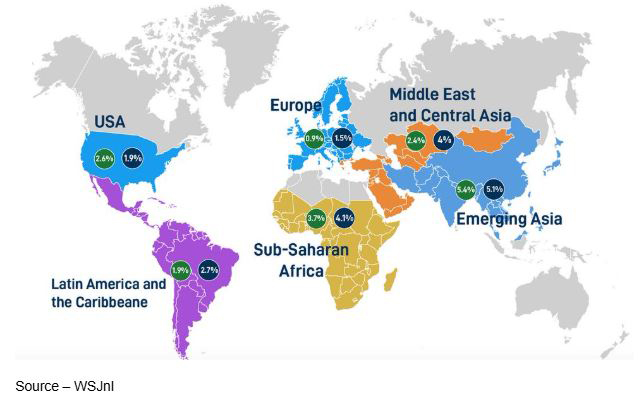
Returning Growth – Despite the dramatic downturn in recent years, economists are forecasting modest economic growth in almost every country by leveraging the best people – regardless of race, sex, age – to produce results.
By having older and younger members on the team, everyone benefits–especially the economy and the organization.
Firms that require expertise and experience need to develop a new set of recruitment and retention strategies that include reduced hours, flexible scheduling – telework, alternative work schedules – and paths to upgrade skills and grow personally/professionally.
As the economy eases up, management needs to take a new look at their talent and organizational needs to ensure they are offering a range of options or … risk losing them.
Experienced, high-performing staffers are more concerned about career advancement and growth and are no longer geographically tied to their present firm in today’s remote world.
Why?
A Pew Research social and demographic study found:
- Older workers are happier workers – 54 percent of those 65 and older were completely satisfied with their job
- A higher percentage of these individuals work because they want to, not because they have to
- By a ratio of two-to-one, they prefer a job with better security (59 percent) over higher pay (33 percent)
- Despite our recent and current tough times, job satisfaction remained high even with pay freezes and involuntary furloughs as businesses and industries struggle to deal with today’s global uncertainties
As for specific reasons for working, older employees emphasize psychological and social factors – feel useful, contribute, be with others.
On the other hand, younger/middle-aged staff members cite classic considerations – support myself/family, live independently, qualify for retirement, receive health care benefits.

In other words, organizations need to add/retain boomers to take advantage of their valuable corporate and industry/technology knowledge, to expand their skills and find ways to share their knowledge with younger colleagues.
Sometimes their view and response to the issue of age is as simple as the Old Man’s answer to the question when asked in Logan’s Run, “I’m as old as I am, I suppose.”
One thing is for certain … we need all of the experience, interest and focused dedication we can muster!
Enjoying the news? Sign up for the Creative COW Newsletter!
Sign up for the Creative COW newsletter and get weekly updates on industry news, forum highlights, jobs, inspirational tutorials, tips, burning questions, and more! Receive bulletins from the largest, longest-running community dedicated to supporting professionals working in film, video, and audio.
Enter your email address, and your first and last name below!


Responses