


Todd Terry
 1
COW Coin
1
COW Coin
Forum Replies Created
-

Some firewire options are disabled and grayed out if a firewire cable is already connected to the camera.
Try this…
Turn the camera off. Remove the cable. Turn the camera on, go into the menu, and make the changes you need… they should be enabled now. Turn the camera back off. Reconnect the cable. Then turn the camera back on.
Then you should be good to go. Hope that works.
T2
__________________________________
Todd Terry
Creative Director
Fantastic Plastic Entertainment, Inc.
fantasticplastic.com

-
Hi Thomas…
I have a little more info for you…
For 2- and 3-perf conversion the “go to guy” is Bruce at the Aranda Film Group. Unfortunately they are pretty far away, in Melbourne. And no, not the one in Florida, either…the one down under. Shipping a Mitchell to Australia might be cost prohibitive.
They are:
https://www.2perf.arandafilm.com.au/Anders Banke at Solid Entertainment sometimes does conversions… however they are primarily a film production company and only do tech work sort of now-and-then, when their schedules permit. Also, a bit far from LA, in Sweden.
They are:
https://www.solidentertainment.seNow, you might have some luck closer to home with Slow Motion, Inc., which is in LA. Im not sure if they do perf conversions, but they do a lot of other kinds of camera mods and might be able to help. Or know someone who can.
They are:
https://www.slowmotioninc.comThat’s about the extent of my resources for now. Hope this helps.
T2
__________________________________
Todd Terry
Creative Director
Fantastic Plastic Entertainment, Inc.
fantasticplastic.com
-
Hi Thomas…
Not sure, I will have to ask some DP buddies that work with 2-perf and 3-perf cameras. I only know about 2- and 3-perf through them, I don’t have any direct experience with them myself… all my cameras are full-frame 4-perf.
I do know there are only a few places in the world that do 2-perf and 3-perf conversion, but I think one of them is in LA… I will have to find out who they are. The other two are in Sweden and Australia.
There are not many places that do the conversions because they are getting pretty rare… and conversion is a pretty precise process that requires replacing the entire camera movement, as well as the gate and some other things. Be forewarned that is it not cheap… I’ve heard some stories of guys spending a fair bit more on the conversions than the did for the cameras themselves.
Do you have BNCR mount lenses? They can be a little hard to come buy these days… although you can sometimes find some pretty nice older Cooke Speed Panchros in BNCR mount, if you like the softer warmer Panchro look (great for, say, a romatic comedy… for an action movie, not so much). Sometimes you’l even see a matched primes set for a reasonable price.
With that big Mitchell I should make you a deal on my McAlister crab dolly I’ve been trying to find a new home for… ha.
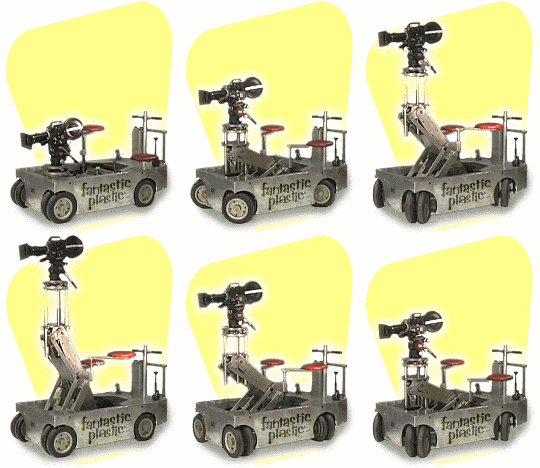
This bad boy can lift a tank, and is built like one, too. It’s overkill for today’s smaller cameras, but your Mitchell would be right at home on it.T2
__________________________________
Todd Terry
Creative Director
Fantastic Plastic Entertainment, Inc.
fantasticplastic.com
-
I would still do it in post, but that’s just me.
I’m not too big a fan of on-camera filtration unless really necessary. With the exception of the occasional ND there are are usually no filters in my matte box. I would usually rather have a clean raw image and treat it later. However, as I said that is just my personal preference… there are plenty of great DPs that feel just the opposite (probably some in this forum).
If you are not longer compositing, then your DoF converter might now give you the more filmic look that you want. I personally, yes, would use my Mini35 if shooting this scenario. If it still looks too videoy you might try just putting some black hosery material over the rear of your primes, but leaving the front clean. That might give you the look that you desire.
Keep in mind that shooting practically in a big white limbo environment doesn’t necessarily make it easier than shooting blue or green screen and compositing everything… especially if your wide shots are wide enough for a full-length head-to-toes view (i.e., “I’m a PC, I’m a Mac”). Those are notoriously difficult lighting situations and require some pretty darn precise DP work. I’ve not done tons of white limbo sets, but have done a few. I’d say with virtually every one of those even though they were shot in a practical white environment that we did end up doing some compositing anyway… filling in spots, getting rid of shadows, etc. If your needs are for the talent to be extraordinarily flatly lit, it’s not that difficult… but if you want any interest in the lighting on the talent that usually creates lighting problems within the rest of the white limbo environment that must be dealt with either practically on set or in post. If your shots are somewhat tighter, then it’s not too hard… just keep your talent a fair distance from the background and light them completely independently, just as if it were a keyed shot.
T2
__________________________________
Todd Terry
Creative Director
Fantastic Plastic Entertainment, Inc.
fantasticplastic.com
-
Todd Terry
February 5, 2009 at 4:34 pm in reply to: What sort of trade shows are worth attending as a vendor?Wow, I think that just depends on the show.
The show we attended was very small, maybe just a couple hundred attendees (we knew that going in) so their rates were in the basement. I think booth space was something like $600. All total with building a booth from scratch, attendance fees, travel, hotel, meals, giveaways, and all that good stuff… I think we ended up spending only about $3000-$4000 on the show total.
Our theory was that if we got even one small-to-medium job out if it, that would several times over pay for having done the show… but as I said even that one direct-from-the-show gig hasn’t come through yet. We have subsequently done work for some of the show attendees, but they were already our clients beforehand.
As for other shows, I think it’s a wide range. As I said, this one was cheap… really jumbo shows can cost tens of thousands of dollars to attend.
T2
__________________________________
Todd Terry
Creative Director
Fantastic Plastic Entertainment, Inc.
fantasticplastic.com
-
Todd Terry
February 5, 2009 at 4:16 pm in reply to: What sort of trade shows are worth attending as a vendor?We attended one trade show last fall… probably the one that was discussed in the previous thread you read.
It was a good experience, but we are still trying to decide whether it was worth it. It hasn’t resulted in any cash coming in yet, but it might in the future.
We picked that show because it was very specific… attendees were only marketing and advertising people in the healthcare industry, and our company produces a lot of broadcast commercials for doctors, hospitals, etc. Plus it was a very small show (so not expensive), and in our home state (although about a 6 hour drive away) so physically getting there with all of our stuff wasn’t bad.
A lot of people were very interested in us, and thought we did great work. However with all of them it was usually “We’d love to talk with you about a project we’re doing in the second quarter of next year” or some variation of that. No one had any immediate needs. We are going to follow up with all of our contacts again later this month.
We had never done a show before, so didn’t have a booth or anything… so we had to quickly throw something together within a couple of days. It was a lot of work, but I must say the results were really great. We didn’t want a run of the mill tradeshow booth and since we claim to be a creative agency we wanted to do something a little different. We had a 10×10 area, so first we bought a fairly standard pop-up backdrop just to have something to build on. We paid something like $300 for it on eBay and it had only been used once (MSRP on the unit was about $1200). Then our art director made a bunch of big foamcoare graphics pieces that would velcro to it. For the floor space, we borrowed some of the vintage furniture from our offices and turned the space into more-or-less an “I Love Lucy” era living room, since our company look is very retro. We had a funky rug, small couch, coffee table, end table, lamps, etc. The furniture also gave us places to put out candy bowls (which actually were very cool large vintage “atomic age” ashtrays), stacks of giveaway DVDs, etc. We produced a custom DVD loop tailored to medical stuff, and had Peter Thomas do a narration track for it that segued between spots. Peter is an excellent national voice (he does Nova, American Airlines, Forensic Files, all the current Burger King stuff) and is great for medical so we think he was an appropriate choice. Normally Peter would get several grand or more just for those tracks, but he’s a buddy and a great guy so he did it gratis. A hidden DVD player fed the video loop to a 42″ plasma screen we had in the booth, but since everything else was very retroy we built a facade for the montitor so it looked like an old console TV. Everyone thought our booth was very cool. Maybe too cool… people tended to stick around and lounge on the sofa a little longer than would be ideal.
It was a good experience. I’m not sure we would do another one right away, but I’m glad we did that one.
T2
__________________________________
Todd Terry
Creative Director
Fantastic Plastic Entertainment, Inc.
fantasticplastic.com
-
I wouldn’t do either one…
Anything that is done to “soften” the image to lose what you perceive as the crispness of HD is also going to soften your edges. You want your edges to be as crisp as you can to achieve the cleanest key possible.
If you want to soften the image I would definitely do that in post. There would be a couple more steps than just softening the footage as you key it. You should composite it with your background plate first and then soften everything. If you don’t want your background affected, you should use your keyed shot to create a traveling matte, and create something like an AVI of your source key that has an alpha channel. You could then soften that without having any blue or green edge bleed.
Likewise I would not use a DoF converter (I think that’s what you are referring to with as a “minipro 35″… there’s a Mini35 and a Pro35 but not a minipro 35). All that will do in this case is give you soft edges again. For a clean key you want a deep DoF, not a shallow one, and your native lens will give you that fine. I’d say the only reason to use a DoF converter would be if you have really great cine primes that are substantially better than your native camera lens… and if so, stop the prime down as much as you can without showing the grain to increase the DoF and keep all your edges sharp.
T2
__________________________________
Todd Terry
Creative Director
Fantastic Plastic Entertainment, Inc.
fantasticplastic.com
-
I know what you mean… some things I will buy used without much worry, but other things, hmmmm… not so much. Monitors are one of those.
If I had needed one, the only reason I would have considered one of those little Panasonics is that I knew they only had a few weeks use on them at the games, were used by people who know what they are doing, and were still considered “new” B-stock with full warranties. Field monitors are so easily abused and so relatively fragile that I would hesitate to consider a used monitor unless I could look at it and try it out first… which pretty much discards eBay or any auction sites.
T2
__________________________________
Todd Terry
Creative Director
Fantastic Plastic Entertainment, Inc.
fantasticplastic.com
-
I know what you mean, the HV20 especially is notoriously hard to focus. Other than that it’s a great little camera for the money.
I don’t have any specific monitor suggestions… but will advise you to keep one thing in mind…
Whatever monitor you end up considering, check the actual specs on it VERY carefully. There are tons of little (7″-ish or so) LCD TTF monitors out there that proudly have the “HD” label on them. The thing is, they are far from HD. They will take in an HD signal, but will not display an HD picture. In fact many (most) of these have only 300 or so lines of resolution… much less than even standard def, let alone high def.
Ergo… most are not very useful for focusing.
An image can look razor sharp on them, but in actuality still be quite soft when you get it back home and check it on a “real” monitor.
I’m afraid I don’t know anything at all within your budget (at least not new) that would be useful for focus assist. One of my favorite lower-priced monitors is the Panasonic BT-LH80WU. It doesn’t show 1080 lines either as it is actually just 800×450… but it does have a pixel-to-pixel mode that blows up the center of the screen to actual HD resolution when needed for a critical look. It also has a focus-in-red function which is a focus-assist feature creating red outlines around sharp images that really does work well. Unfortunately, it’s about four times your budget, at around $2000. After the Bejing Olympics there were tons of them on eBay, NBC bought bunches of them for the games and they were being liquidated dirt cheap, I saw some going in the $600-$700 neighborhood. You might still be able to find one of those, they were considered “B” stock and still had factory warranties.
T2
__________________________________
Todd Terry
Creative Director
Fantastic Plastic Entertainment, Inc.
fantasticplastic.com
-
[Mads Nybo Jørgensen] “I know of a couple of very “advanced” people that also get freelancers/assistants to sign that they wont use or pass on any of the techniques that they are taught”
I think yes, that happens to some degree.
Quite a few years ago I developed a film simulation process that I called FauxFilm. Now, mind you, this was long before the days that 24p cameras even existed, or Magic Bullet or any of the early film simulation software. It could be used live, or with NLEs (which were just coming into play). It put a perfect 3:2 pulldown into 60i footage, pretty much exactly like the company FilmLook did (anybody remember them?). The thing is, it was actually a painfully simple process, I actually just stumbled upon it by accident. On a couple of occasions I did have to have other editors in working, and it was impossible to hide the “secret” of how it worked because of its simplicity. I didn’t make them sign anything, but I did make them swear on their grandmothers’ graves that they wouldn’t take the technique elsewhere, and as far as they know, they didn’t. In hindsight, I might have been overly-trusting.
Today, we don’t exactly do anything that’s super-secret, but we are sort of known as the “McGuyvers” (or some might argue “McGrubers”) in the market, with lots of little tricks, gimmicks, and processes that make things look better and cost less. We’ll sometimes get the calls from freelancers saying “Put me on your crew call list, I know you guys would be fun to work with.” What is pretty easy to tell is that some of them simply want to get onto set or location not so much to work, but more just to see how we do things and take that knowlege elsewhere or to their own companies, which are sometimes our competition. Well, we generally don’t hire these guys. Some are blatent enough to say “I really wanna learn to light like you do” or “I want to see how you direct,” or some variation of that.
Sorry, I’m running a business in a competitive market, not a film school.
And I really don’t think there is anything wrong with that position.
I’m glad to share my limited knowlege with the great folks here in the worldwide COW community, and learn much from all your wisdom as well. And I’ll help out college or high school kids in their production classes all they want, and more. We do that all the time. And I’ve happily taught a few tricks to eager freelance crews when we were shooting on location in other states or across the country. But other companies in my area who are going after the same client base as ours?… or even after our current clients? Nah, not so much.
T2
__________________________________
Todd Terry
Creative Director
Fantastic Plastic Entertainment, Inc.
fantasticplastic.com