

Liberty University on why broadcast technology isn’t just a technical investment, it’s a human one

When universities mean business
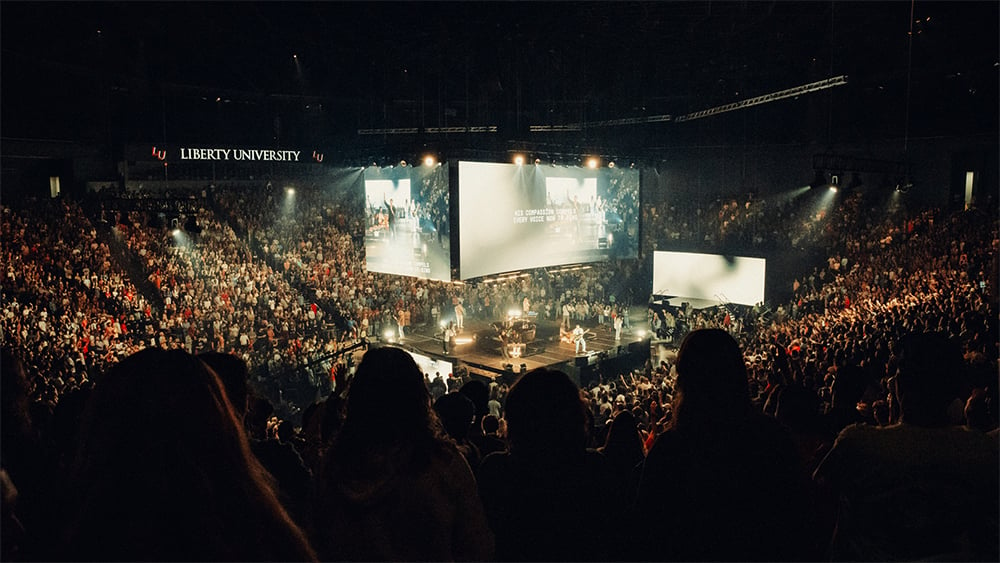
It’s no secret that college sport in the US is a big deal. But in the minds of many, there’s still a somewhat local mindset to the whole setup: tailgating with beer and a BBQ, flag waving in the bleachers, local commentary over a static-ridden radio. Of course, that’s largely the nostalgia talking. In reality, college sports are big business, and the expectation from conferences, broadcast partners, and fans is that university-produced content meets professional standards. This means that from a broadcast perspective, what was once the exclusive domain of networks and sports leagues has become a standard tool for universities seeking to professionalise their internal and external communications.
But the value runs deeper. The same infrastructure that delivers a Saturday football game to ESPN+ can also stream a guest lecture to remote students, broadcast an academic conference to the wider scholarly community, or produce a commencement ceremony that distant family members can watch live. More importantly, it gives students hands-on experience with the same technology they will encounter in their careers.
Building for progress
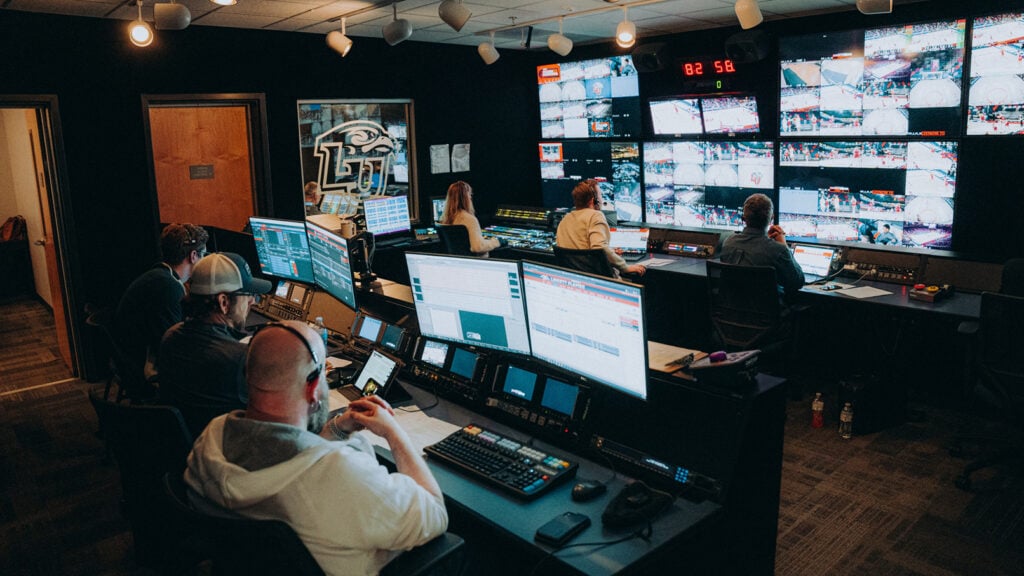
For us at Liberty University, the priority was building a production operation capable of delivering over 1,700 events annually. That portfolio includes more than 300 sports broadcasts, nearly 500 live events across all genres, and approximately 100 studio show recordings each year. Our facilities span five physical control rooms of varying sizes, a mobile unit, and three studios dedicated to sports programming – including our weekly show ‘Flames Central’, which airs on ESPN+. These studios also serve our academic departments, with students rotating through different production roles in news-style programs. When our students enter their first ‘real-world’ internship in the field of broadcast, they’re not the ones doing coffee runs – they are primed and ready to get stuck-in to the real stuff, having worked extensively already with the latest generation of broadcast technologies.
Our infrastructure is built around multiple SDI routers connected via fibre optics across campus. Until recently, we had not implemented IP video solutions, and we were not looking for a wholesale replacement. We needed a tool that would enhance our existing workflows while giving us a path forward. After conducting extensive research and consulting with Digital Video Group, the company who were instrumental in advising upon and carrying out the upgrade of our initial architecture to a hybrid IP setup, it became apparent that Bridge Technologies’ IP production probe – the VB440 – would not only meet the needs we had already established for ourselves, but actually allow us to push forward in terms of what we could achieve technologically and creatively. Using SDI‑to‑IP routing, we have been able to integrate the VB440 into our in‑house orchestration platform, LIRA, which serves as the operational control layer across our broadcast infrastructure. This allows engineers and technical managers to log in via a web browser from anywhere – on campus, at home, or on the road – to view or adjust routing configurations, all supported by a constant stream of real‑time data from the VB440.
But it hasn’t just aided technical management, it’s been central to core creative and QC production functions. Camera painters use it for shading, audio engineers use it to balance all aspects of sound production, whilst remote engineers check programme feeds, monitor AV quality and sync incoming sources.
Most importantly, because the VB440 supports multiple simultaneous users, we are not buying separate devices or servers for each function. One tool serves the entire team – and that’s crucial in an environment where we run a multi-generational team that blends highly experienced analogue engineers accustomed to traditional broadcast methods with newer engineers who bring fresh perspectives and understanding.
Indeed, the VB440 has been so successful in its support of diverse and tailored workflows for the team that we’ll be launching a second VB440 in a fully IP production environment. It will leverage NMOS routing and the ability to display every part of the probe’s functionality on iPad screens, all connected back to our wider system through LIRA. This will all be supported by 2110 Solutions, Bridge Technologies’ North American Business Partner.
Scoring a technology touchdown
US university sport is undoubtedly big business. But it is not the only reason to invest in professional broadcast technology. It provides the base from which educational institutions of all types can extend their core offering; bringing conferences to wider audiences, helping remote students gain access to lectures, and – perhaps most importantly – giving students real-world experience to kick-start their careers. At Liberty, our campus setup has not just been a technical investment, but an educational one, and one we’re hugely proud of.
Enjoying the news? Sign up for the Creative COW Newsletter!
Sign up for the Creative COW newsletter and get weekly updates on industry news, forum highlights, jobs, inspirational tutorials, tips, burning questions, and more! Receive bulletins from the largest, longest-running community dedicated to supporting professionals working in film, video, and audio.
Enter your email address, and your first and last name below!


Responses