


Immersive Studio Metaverse Stage Tackles Post with Blackmagic Design

New narrative projects rely on DaVinci Resolve Studio for immersive post workflow.
Leading immersive studio Metaverse Stage brings audiences right into the story with a narrative approach to immersive filmmaking. Telling tales of long ago royal courts in “Henry VIII in Warwick” and showcasing the beauty of today’s rugged Colorado landscapes in “Aspen Cowgirl,” Metaverse Stage’s latest projects tap into a deeper layer of storytelling by placing the viewer directly within the unfolding narratives.
“For example, with ‘Aspen Cowgirl,’ we wanted to take immersive storytelling in a different direction,” noted Metaverse Stage Director Keeley Turner. “Most immersive productions today still feel like tech demos, focused on showing capability rather than storytelling. We wanted to do the opposite: tell a heartfelt narrative that simply brings viewers into one of the most beautiful places in America, Aspen, CO, and let them experience an authentic slice of Americana that’s quietly disappearing from modern life.”
After shooting both films with a Blackmagic URSA Cine Immersive digital film camera, Metaverse Stage relied on DaVinci Resolve Studio across editing, color grading, sound design using Fairlight for ASAF and VFX, crediting the powerful combination of the software and the ability to preview scenes directly using Apple Vision Pro.
“Having that immediate, immersive feedback made a huge difference in how we approached pacing, continuity and scene transitions,” Metaverse Stage Producer Hugh Hou said. “I often used Resolve’s Stream to visionOS feature to review sequences in real time, experiencing each cut exactly as the audience would inside the device. At times, I even brought the DaVinci Resolve interface into Apple Vision Pro through Mac Virtual Display, so I could edit while simultaneously viewing the immersive 3D playback in full depth.
“This hybrid workflow allowed me to judge timing and emotional rhythm more intuitively because, in immersive storytelling, even a few frames can change how comfortable or natural a transition feels. Seeing the edit in the headset helped ensure every scene flowed smoothly and maintained that sense of presence we worked so hard to create.”
Honoring Historical Accuracy for “Henry VIII in Warwick”
DaVinci Resolve Studio’s Fusion page was used extensively for the films’ VFX, helping remove items that would detract from viewers’ full immersion in the stories.
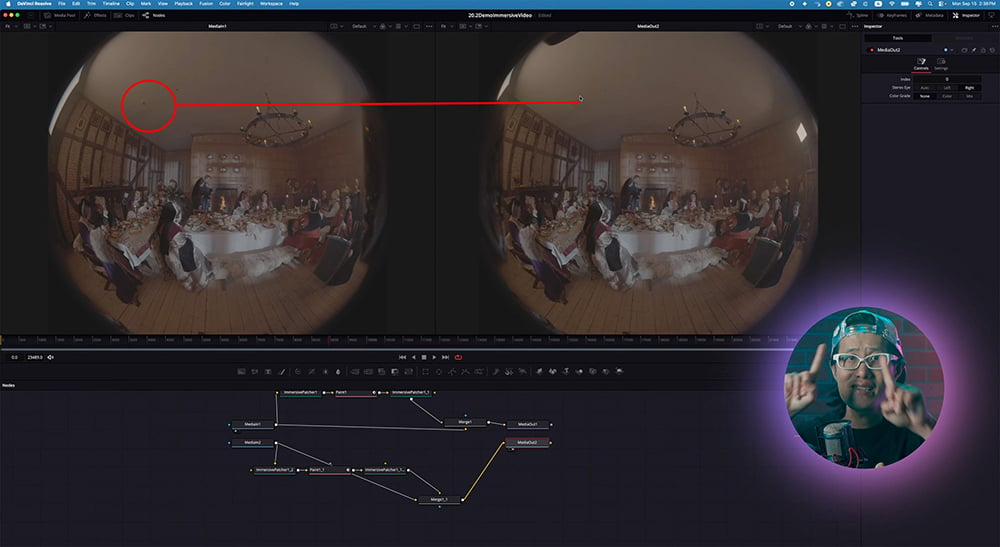
“For example, in ‘Henry VIII in Warwick’ we ran into an interesting challenge: filming inside a real, centuries old historical site in England that, by modern regulation, must have visible fire alarms installed on the ceilings. Of course, we couldn’t remove or cover them during production, so we had to keep them in the shot and address them later in post,” explained Hou. “We relied heavily on Fusion for this cleanup work.
“The software’s new immersive patcher and PanoMap tools allowed us to convert Apple Lens Space into a flat format for precise 2D rotoscoping and paint fixes. That workflow was a lifesaver. It allowed us to treat immersive footage with the same speed and precision as a traditional VFX shot.”
For nighttime castle scenes that had limited practical lighting beyond candles and fireplaces, Hou also used DaVinci Resolve Studio to apply a custom denoising workflow that retained all the fine candlelight textures while keeping the image clean and immersive. “The result is stunning. With Apple Vision Pro, viewers can see every detail of the Tudor setting, from the reflections of the flames on Henry’s armor to the subtle glow of the candles across the banquet table, all while feeling like they’re truly there in the room,” said Hou.
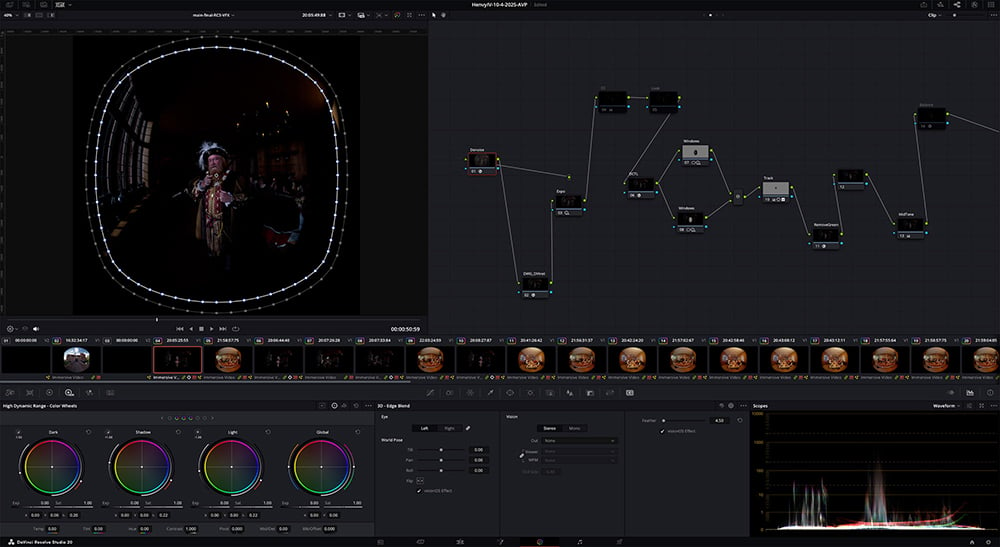
He continued, “In addition, we used edge masks in Resolve’s color page to cover minor rigging, such as the legs of light stands that occasionally appeared at the edge of the 180 degree frame. This simple, efficient approach saved us a tremendous amount of time on patching while maintaining a completely clean, immersive final image without a burn in mask.”
Stabilizing Country Roads for “Aspen Cowgirl”
Hou noted that in “Aspen Cowgirl,” they pushed the URSA Cine Immersive beyond locked off shots and into moving camera work in nature. For many sequences, Metaverse Stage used tools such as a technocrane and camera car to achieve controlled cinematic movement. However, some shots required a more practical approach, which required additional work in post.
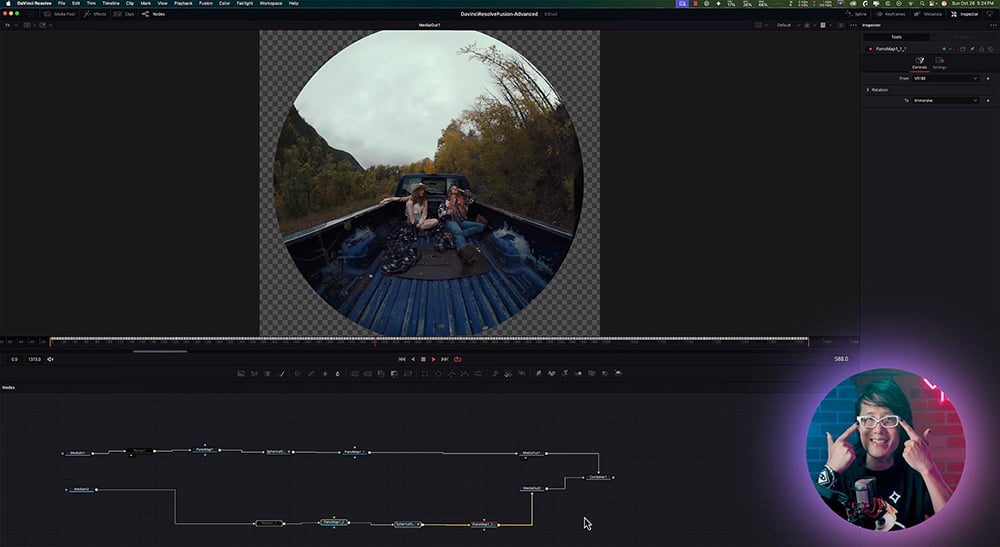
Hou detailed, “For one sequence, we wanted the audience to feel as if they were riding in the back of a vintage American pickup truck alongside the two actresses. To achieve that, we hard mounted the camera to the back of the truck so the movement would stay naturally connected to the vehicle, helping reduce the kind of disconnected motion that can cause discomfort in immersive viewing.
“The challenge was that the mountain road was extremely uneven, introducing both large bumps and constant micro jitter. To refine those shots in post, we used DaVinci Resolve Studio’s latest Fusion tools, including PanoMap and Spherical Stabilizer. With the VR180 spherical stabilization introduced in Fusion 20, we were able to smooth motion that would have been difficult or impossible to fully control on location.”
“This kind of post production workflow allows us to achieve cinematic immersive movement without relying on more complex rigging for every shot,” he continued. “For independent filmmakers, understanding what can be accomplished in post is essential. By planning for those tools during production, we can capture ambitious moving shots that might otherwise be too expensive, too difficult, or ultimately unusable.”
Learning the Basics of Immersive Storytelling
Hou concluded by giving advice for others looking to explore the new world of immersive storytelling: “My biggest advice is don’t be afraid to experiment, but make sure you understand the fundamentals first. Immersive filmmaking has its own language and rhythm, and there are now well established best practices that can really elevate your storytelling.
“Learn the basics: move the camera with intention, pay attention to talent blocking, and always think about the viewer’s gaze direction. Keep your cuts minimal and let scenes breathe. Sound matters just as much as visuals, so invest time in spatial audio; it’s half of the immersive experience. Once you’ve mastered those principles, then you can start breaking the rules creatively. But always review every take inside an Apple Vision Pro before you move on. Don’t assume anything will look or feel right until you’ve actually experienced it immersively, because even small details can make a huge difference in comfort and storytelling flow.
“And most importantly, go outside, film in nature, and tell stories that connect people to real places and emotions. Don’t worry too much about numbers or ROI right now. This is still a new art form, and it’s evolving fast. Be bold, be curious, and be one of the pioneers shaping what immersive cinema can become.”
Enjoying the news? Sign up for the Creative COW Newsletter!
Sign up for the Creative COW newsletter and get weekly updates on industry news, forum highlights, jobs, inspirational tutorials, tips, burning questions, and more! Receive bulletins from the largest, longest-running community dedicated to supporting professionals working in film, video, and audio.
Enter your email address, and your first and last name below!


Responses