

DHD Introduces AI-Based Audio Noise Reduction to XD3 IP Core

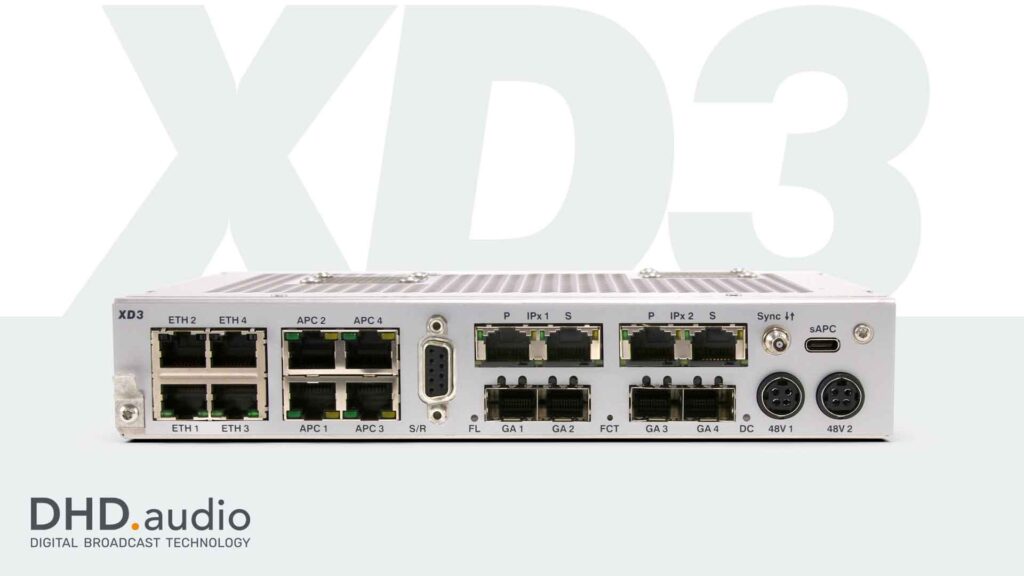
The accompanying image shows the rear panel of the DHD XD3 IP Core.
DHD announces that AI-based audio noise reduction is now available as a powerful new option for its XD3 IP Core. Developed in cooperation with ai-coustics, audio noise reduction created great interest when demonstrated as part of DHD’s September 2025 IBC. It is now fully deliverable on a licence basis for new and existing XD3 modules. The concept will be promoted on DHD booth C3132 at the April 19th – 22nd NAB Show.

“The AI-based noise reduction process is much more effective than traditional filter-based tools,” comments Christoph Gottert, DHD international sales manager. “Potential applications include the reduction of background distractions from source content such as sports commentaries or traffic noise from outdoor news reports. Processing intensity can be adjusted quickly and easily at a DHD mixing console or remotely. Three instances, each stereo, can be run in parallel on one XD3 core.”
Cores form the heart of every DHD system, processing all the audio as well as connecting control surfaces such as the RX2, compact SX2, desktop DX2, and touchscreen-controlled TX2. DHD cores also perform input/output routing and interfacing with the outside world. IP audio feeds and IP-connected remote device control can be closely integrated. Automated workflows and product virtualisation are also supported. Connectivity options include Audinate Dante, AES67/RAVENNA, AES3/EBU, Gigabit Audio, APC, MADI, and analogue.
Three modules are available in the XD3 range: a controller and IP core, a 12k router extension, plus a DSP extension. These can be operated individually or in redundancy mode as a fully synchronous main and standby pair including seamless switching between the two devices.
The standard XD3 IP core comprises a single DSP processor supporting up to 24 faders and 48 summing busses. Also available is a three-DSP version supporting 64 faders and 96 summing busses, plus a five-DSP version supporting 96 faders and 126 summing busses. Each DSP module uses 40-bit floating-point processing for fader channels, channel processing, fixed processing, and summing operations. Additional routing capacities are provided to allow the use of up to 4, 16 or 24 Gigabit Audio ports respectively. Additional memory for channel delay and program delay is added with each DSP module.
Enjoying the news? Sign up for the Creative COW Newsletter!
Sign up for the Creative COW newsletter and get weekly updates on industry news, forum highlights, jobs, inspirational tutorials, tips, burning questions, and more! Receive bulletins from the largest, longest-running community dedicated to supporting professionals working in film, video, and audio.
Enter your email address, and your first and last name below!


Responses