

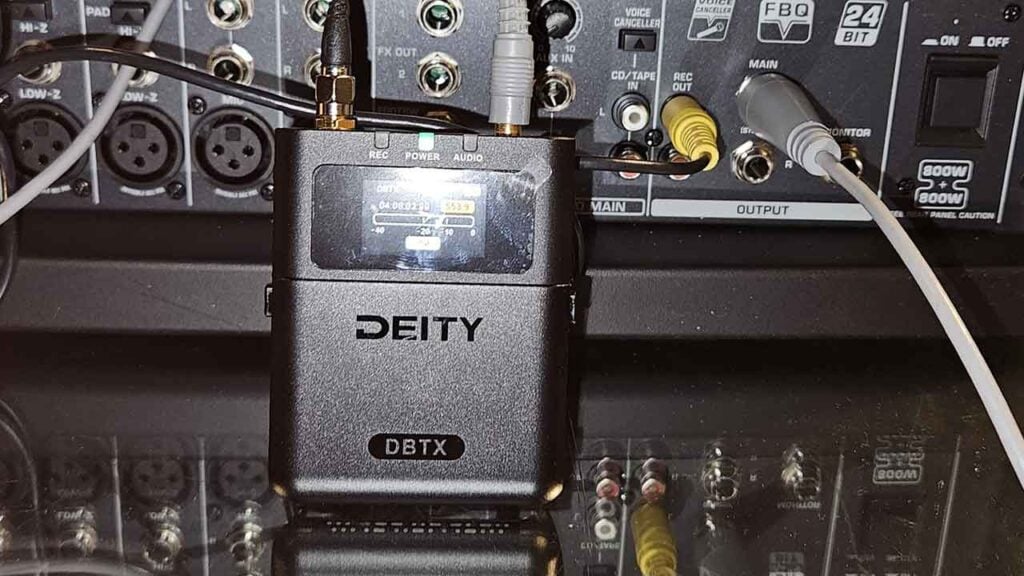
Deity Microphones: Theos Digital UHF Wireless System Review

Street Price: $1100
Deity Microphones is a relative newcomer to the microphone business starting in 2018. It was a company founded by a location sound mixer that wanted better equipment for the industry. Deity made a splash with their first on camera mics that many liked and received a number of industry awards and nominations. For this review we are going to be looking at Deity’s Theos dual channel wireless microphone system.
The Theos system’s main components are the dual channel receiver, two transmitters – recorders, two plug in omni-directional lav mics, mic clips, antennas, belt clips, XLR and 3.5mm camera cables, a cold shoe mount for the receiver, USB-cable, two 32GB micro SD cards, Deity’ own brand of lithium AA batteries and a very heavy duty carrying case. Everything fits nicely into that case, which is not something to be taken lightly.
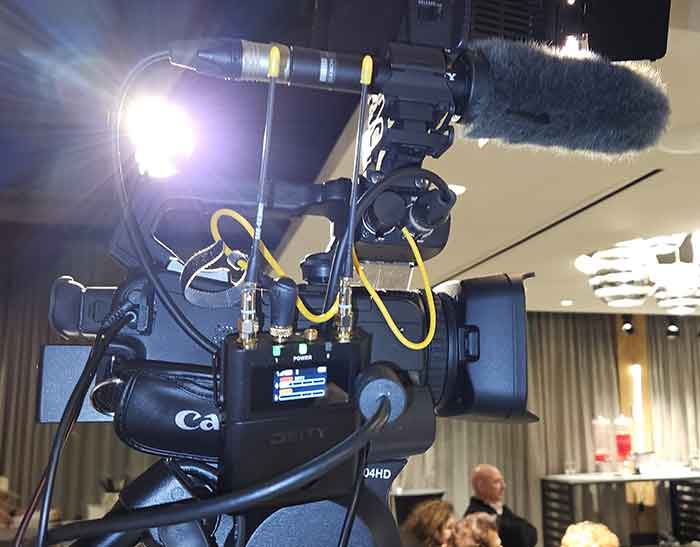
One of the unique features is that the transmitters can also be used as recorders. Currently they cannot transmit and record at the same time in the United States, as another mic company, Zaxcom, has a patent on having both features active at once. You can choose either function, but not both in the USA. Outside the USA, it can be enabled. While Deity did have a licensing agreement with Zaxcom on a previous model of recording mic transmitters, the Theos line doesn’t have it. If not transmitting, the DBTX transmitters will act like the TASCAM DR-10L / Pro products that look like wireless lavaliere transmitters, but only record.
Before you run out in the field with the Theos system, its good to spend some time getting to know it, as some things are very different, especially if you are like me coming from a 25 year old Sennheiser G2 wireless system. The Theos system has a feature that lets you find the best open frequencies. That is fairly easy. You turn on the receiver, and it finds the two best frequencies. Then you turn on the transmitters, and set them to those frequencies. Getting the microphone input levels where you want them took some experimentation. On my Sennheiser G2 lav transmitter, I need to set the mic sensitivity to -10db, and the Theos had to be set at 00db and mic level 5v. There is a handy headphone jack on the transmitter so you can plug in and check how it sounds at the source.
There are a couple ways to set the frequencies for the devices. I frequently shoot in the same places, so I know which are the good frequencies for the neighborhood. In those areas, I know which frequencies I can manually dial in. If you are in an unfamiliar area I highly recommend the third party app called “Sidus.” This app pairs via bluetooth to the transmitters and receiver, scans for the best frequencies and assigns all of the components to them. This operation take about a minute, and works great.
Sidus allows other operations such as syncing timecode recording and remotely triggering the record feature. I highly recommend using the app. It is by far one of the easiest ones out there. If you are in a UHF heavy area like Los Angeles, using the app to find open frequencies is a godsend. Having the ability to record as a back up is a good fail-safe.
I had the opportunity to use the Theos system on a few real real shoots. The first shoot was at the dojo where I take Jujitsu lessons. I was getting testimonial interviews with parents of kids in the youth classes. The lavaliere mics that are supplied with the Theos system are a tiny diameter omni-directional microphones. These picked up a bit of surrounding noise in the dojo. After the first interview, I tried going outside the front, that was an outdoor walkway. The switch of location traded one problem for another. I had less class noise, but a bit of echo from the hallway. Fortunately, it wasn’t too problematic, and I was able to tune out the background and echo in Premiere Pro with Boris FX Crumple Pop audio plug-ins.
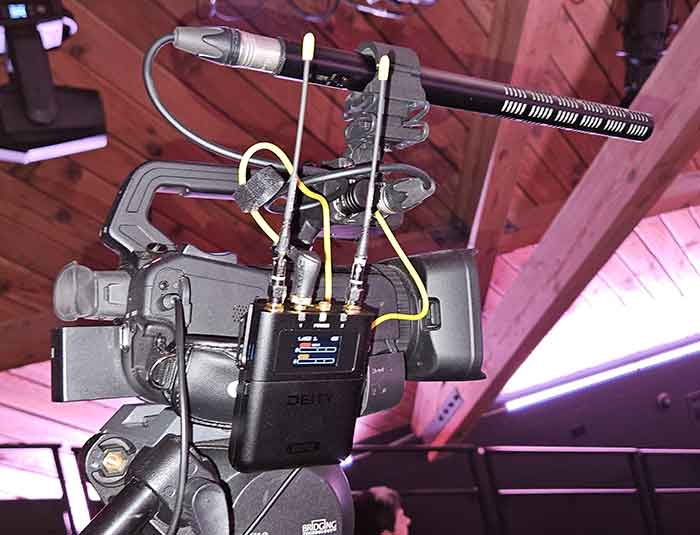
Next I tried to use it for live AV, there the mics were being output via PA system for a live audience. Even though I thought I had it working, five minutes into the shoot, I started getting feedback, even with my feedback suppressor on. I spoke to Deity about this, and was told that the lav mics included with the system do not work for “live event” situations like theater or houses of worship. If you wanted to use the system for that, you’d need to use cardioid. There are compatible cardioid mics that are available from other manufactures that range in price from about $30 to $700 depending on what your requirements and budget is. I hope to give this a try at some point.
The next shoot that I had was fairly easy. It was an evidence video for a court case. The plaintiff gave a tour of a house he was renting, where the landlord didn’t make necessary repairs, and when it rained the roof leaked and caused black mold through out the house. The audio came out perfectly as it was indoors. No post production work was needed.
I had another shoot pop up shortly after the previous one. It was a classical piano concert with commentary by the pianist. I asked the pianist if he could wear the lav and transmitter, but he said it would be to distracting. I looked to plug in to the house’s sound system to get a feed off the board, to my Sennheiser G2 set up, but it was one of the newer “virtual” mixers, a box with ins and outs, and a tablet to run it. While I found the correct output, no one at the venue know how to route it. I went back to the Theos lav and transmitter. I taped the lav just below the venue’s hand held mic, and I clamped the transmitter to the on the mic stand on the stage. At first I thought there was a a bad hiss, when listening to the live feed. In the studio, on my edit system speakers it sounded clean, just needing some echo removal with Boris FX’s Crumple Pop audio filters. I turned out that the camera’s headphone output got set too high. I guess that was on me.
My next shoot was fairly simple. A Shure SM58 on a podium for the featured speaker, going through my company’s Behringer 1680S sound system. This gave me a chance to test the Theos’ line level input. I routed one of the powered mixer’s 1/4” outputs through a 1/4” to 1/8” cable, to the transmitter. You must remember to go into the transmitter’s menu and set it for line level. At one point in the set up for this I had a weird issue of one of the transmitters being muted. There was no switch, and nothing in the menu. I tried different frequencies, but nothing worked. I tried the other transmitter, and it worked. I tried resetting both frequencies, but somehow, both transmitters went to the same frequency. In the end, I only needed one transmitter, and it worked fine, and was a very clean signal.
One discovery I made about Deity’s own lithium-ion (non-rechargeable) batteries: while they worked for three 2 hour shoots, and the battery gauge said full, by the fourth shoot, it quit without warning. So, it showed full battery, we tested it, all was well. Five minutes before show time, and it went dead. I didn’t notice a warning on the receiver. When lithium-ion batteries go, they go quick. I had expected them to go at some point, so I did have extras ready.
I also tested the Deity system with rechargeable Ni-MH batteries. They aren’t fancy brands. I have some from Harbor Freight, CVS and AC Delco, many 10 – 20 years old. Once you set the battery type in the units menu to the proper battery type, they worked fine.
On my next shoot, I was just a simple recording of a student rabbi’s sample sermon. The problem with the mic muting popped up again. I had time to work on it, so I explored the menu. On the transmitter, I found a setting under “system” for “reset.” I used that, and the mute went away. The shoot went fine and the sound was flawless.
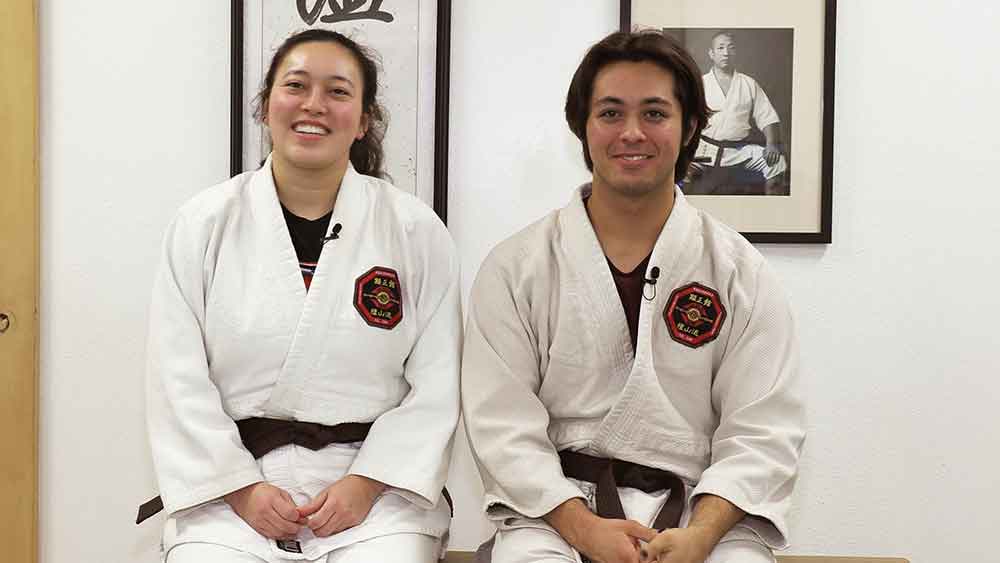
For my next test, I finally got two people together to be on camera at the same time, to test both transmitters working at the same time. I am working on a promo video for the Jujitsu dojo that I go to, Kenshokan Martial Arts Academy. I had two brown belts, who are in their twenties, talk about how they started in the dojo over a decade ago, and how the art not only effected their lives, but they became employees and junior instructors. The sound was over all very good. The only problem, that wasn’t too much of a problem in this case, was each mic picked up both people so well, you couldn’t really tell which mic was on which person. This goes back to the single interviews I had done before where the included lavaliere mic heads had a wide omni-directional pick up pattern and pick up a good amount of surrounding noise. My 25 year old Sennheiser G2 lavaliere mics have a narrower pick up pattern and get less surrounding noise. The nice thing about the Theos system, is the lavaliere mics are not proprietary, and in fact use the same connector as Sennheiser. That means I can use the Sennheiser or any other mics with the 3.5mm screw in connector on the Theos transmitters.
Unlike most new systems I have tried in the last 5 years or so, I don’t think I ever had a dropped signal during a shoot. Even working in the busiest parts of Los Angeles, where the signals always came through due to the system being able to scan and lock to the clearest frequencies. While I did have a few problems during setups where the mics would not unmute and the transmitters were locking to the same frequency, doing a system reset always cured the problem. These mics have tiny computers in them. Just like when your regular computer gives you issues, rebooting usually fixes the issue. During the course of location production, the units had their share of rough treatment, but never had an issue because of it. Being able to use the transmitters as recorders is also a very handy feature.
The only thing that I could ask Deity to add to the system would be a plug-on transmitter for hand held mics. I use those a lot. If the included microphones aren’t working for you, you can easily get other compatible mics from many other manufacturers, at many price points, to meet your needs. If you are looking for a well built, reliable lavaliere microphone system that won’t break the bank, the Theos system may be the one for you.
Enjoying the news? Sign up for the Creative COW Newsletter!
Sign up for the Creative COW newsletter and get weekly updates on industry news, forum highlights, jobs, inspirational tutorials, tips, burning questions, and more! Receive bulletins from the largest, longest-running community dedicated to supporting professionals working in film, video, and audio.
Enter your email address, and your first and last name below!


Responses