


DaVinci Resolve Studio Used for Taketoshi Sado’s Perfume Cold Sleep -25 years Document-

DaVinci Resolve Studio easily handles multiple formats from more than 25 years of footage for editing, VFX and grading.
Celebrating their 25th anniversary, techno pop group Perfume has gained a large fanbase not only in Japan but also overseas. Perfume “Cold Sleep” -25 years Document- is a documentary that explores the trajectory of the group’s 25 year career, as well as the story behind their decision to go on hiatus, referred to as “cold sleep,” at this milestone.
The film is directed by Taketoshi Sado of NHK Enterprises, who has worked with Perfume for many years as a producer of music television programs. He also directed Perfume’s first documentary film, WE ARE Perfume -WORLD TOUR 3rd DOCUMENT, released in 2015.
Online editing and grading for this project were completed using DaVinci Resolve Studio. We spoke with Sado and online editor Yoshihisa Kato about the production and post production of the film.
Massive Footage: Capturing 25 Years of History
Sado: “Originally, there was a major project planned for Perfume’s 20th anniversary, and filming began around their Coachella appearance in 2019. However, due to the COVID-19 pandemic, production activities became difficult, and the documentary was later restructured around their 25th anniversary. I had no idea they would decide to go into cold sleep while filming, so I was personally very surprised when that moment happened.
“Including archival footage, total material amounted to 50 terabytes. For live rehearsals, we filmed in 4K using three to four cameras, which resulted in a large amount of footage. Footage from before Perfume’s breakthrough, such as live performances and interviews, was difficult to obtain, so we used VHS and MiniDV materials owned by their agency and the members’ families. Finding decks capable of playback was also challenging; we borrowed privately owned equipment, but many tapes still couldn’t be played.”
A Flexible Workflow with DaVinci Resolve Studio
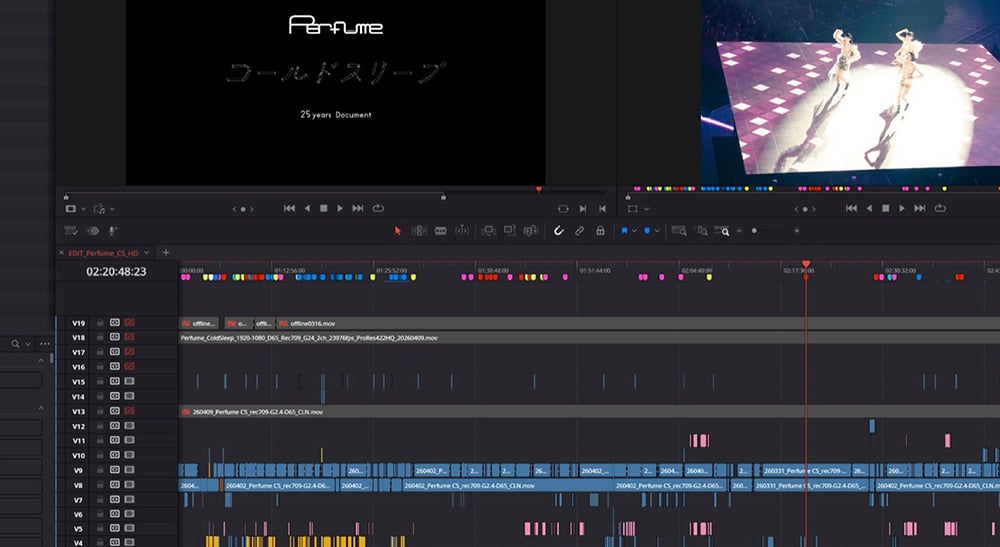
Sado handled offline editing, while online editing and grading were carried out by Yoshihisa Kato of CRAZYTV Creative using DaVinci Resolve Studio and a DaVinci Resolve Mini Panel.
Kato: “We have been using DaVinci Resolve for grading for many years, but with last year’s update, the challenges we had with editing were resolved. Since then, we’ve actively started using it for online editing as well. For this project, we anticipated moving back and forth between grading and online editing on a tight schedule, so we determined that a DaVinci Resolve only workflow would be the most efficient. As a result, we could easily make color adjustments during editing, allowing us to complete the project without compromising the director’s creativity.”
Sado: “Despite working with footage captured under a wide range of conditions, we were able to quickly achieve the results I envisioned in grading, editing and processing. I was also impressed by how fast DaVinci Resolve is at rendering. It’s excellent. It was fantastic not having to constantly calculate export times backward when planning my workflow, which greatly reduced stress.”
Various Approaches to Enhancing Footage Quality
The film incorporates a wide variety of footage, and presenting it seamlessly as a single work was a major challenge.
Kato: “We had all kinds of material, including older footage, clips shot on iPhones and footage with unknown color spaces, so I anticipated difficulties in matching tones. To address this, I used ACEScct and set the appropriate IDT for each type of footage to make adjustments. Older footage was upscaled using DaVinci Resolve’s AI based Super Scale.”
Documentaries often require prioritizing the subject over image quality, as scenes cannot be reshot. Sado faced this challenge firsthand while operating the camera himself.
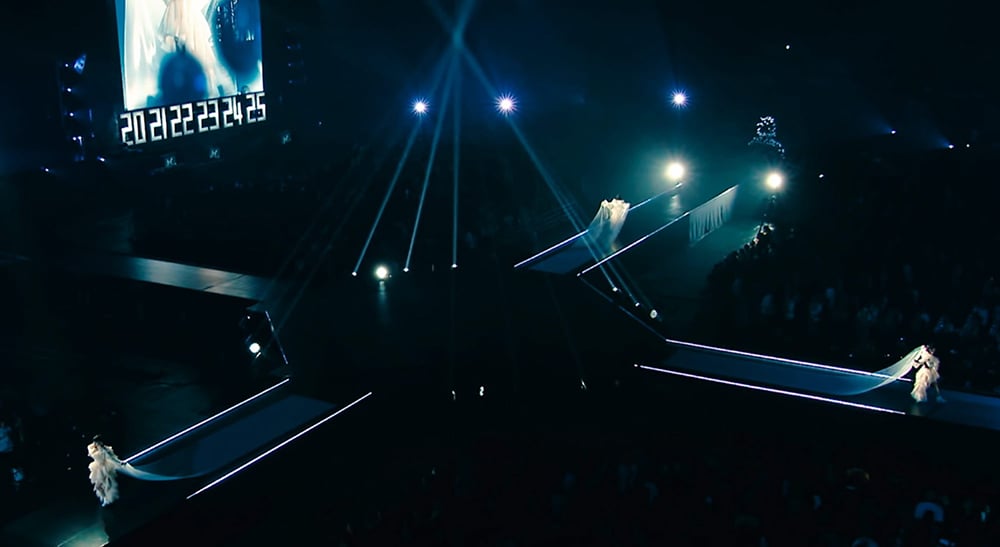
Sado: “I used a camera without image stabilization, but adding a gimbal would have reduced mobility and made it difficult to move quickly in tight spaces, so I shot handheld. As a result, camera shake was unavoidable. There were also situations where lighting conditions changed suddenly, and I couldn’t adjust the aperture in the middle of shooting, so I had to keep filming as it was. Since Perfume is a three member group, there were also many times when I couldn’t keep all of them in focus.”
Kato: “Since this wasn’t a project where lighting could be fully controlled, there were scenes that were too dark, as well as cuts with significant camera shake. I carefully adjusted everything to achieve the best possible quality for a film. One of DaVinci Resolve’s greatest strengths is that it provides all the tools needed to achieve the best possible result. With the stabilizer, applying too much can look unnatural, so I limited it to removing micro vibrations and creating smooth motion. Magic Mask and Depth Map were useful for separating subjects from the background during adjustments. I also used Qualifiers mainly to enhance skin tones.”
Sado: “LED screens are commonly used in concert venues, and they often cause moiré in the footage. For music productions, it’s really a constant battle against moiré. We made efforts to reduce it as much as possible to ensure a comfortable viewing experience.”
Kato: “On the Fusion page, I masked the moiré areas and blended frozen and slowed footage to make it look natural. We also frequently used Deflicker to reduce lighting flicker.”
The Benefits of Rapid Development
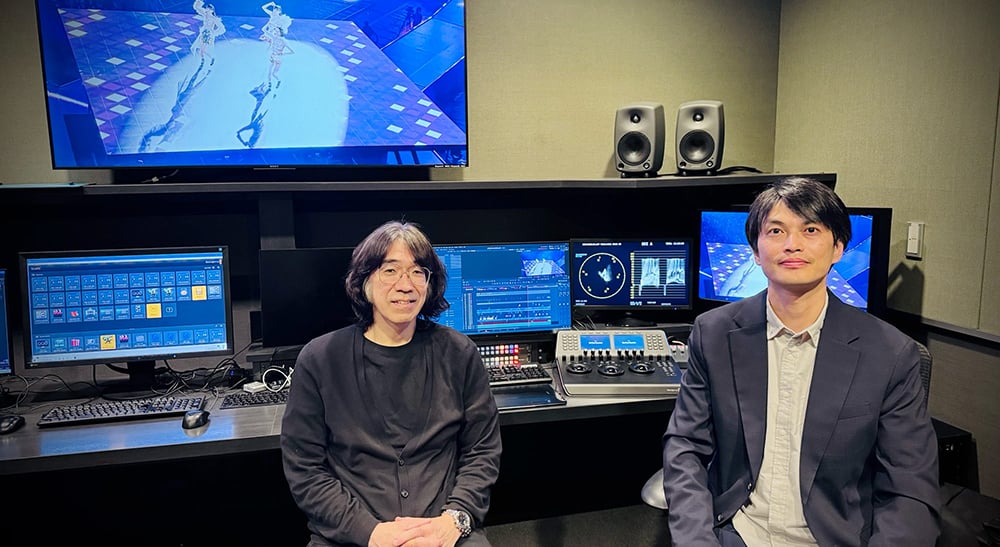
After the project was completed, DaVinci Resolve 21 was announced. Kato highly values both the frequency of updates and the software’s stability.
Kato: “DaVinci Resolve remains stable even with new versions. Other software often has many bugs, so we don’t immediately adopt updates, but we tried the beta version of DaVinci Resolve Studio 21 right away. It included many features we had been wanting for post production.
“The newly added AI UltraSharpen is impressive. Traditional sharpening has its limits and can degrade the image when overused. With this, I could have improved slightly out of focus shots even more. Still, I really appreciate how the software continues to evolve. Some of our requests have been reflected in updates, which is one of the reasons we’re using DaVinci Resolve more frequently.”
Enjoying the news? Sign up for the Creative COW Newsletter!
Sign up for the Creative COW newsletter and get weekly updates on industry news, forum highlights, jobs, inspirational tutorials, tips, burning questions, and more! Receive bulletins from the largest, longest-running community dedicated to supporting professionals working in film, video, and audio.
Enter your email address, and your first and last name below!


Responses