


Todd Terry
 1
COW Coin
1
COW Coin
Forum Replies Created
-

I’m with David… betting the likely culprit is Canon’s proprietary 24f or 30f modes.
Was the footage checked on location (and played ok in the original camera)? If so, I think that’s your problem… because non-Canon equipment will generally play Canon 24f or 30f when shot in SD just fine, but will genereally not play it if it was shot in HDV.
If that’s the problem, yes, you will need either the original camera (or another Canon camera, even something like the little HV20) to use as a deck… or one of the very few decks that can accommodate the Canon f-mode footage, such as the Sony M35.
T2
__________________________________
Todd Terry
Creative Director
Fantastic Plastic Entertainment, Inc.
fantasticplastic.com

-
Todd Terry
December 11, 2008 at 3:54 pm in reply to: Overexposed windows, scrims, gels and tungsten lighting[Mark Suszko] “HMI’s work but they are expensive, make a LOT of heat, and draw a lot of power.”
Two-thirds correct. HMIs are very expensive, and draw a lot of power (make sure you have a lot of dedicated circuits). However until you get into the really really big instruments (say 12Ks or 18Ks) they are not nearly as hot as many people fear. Lumen-for-lumen they are not nearly as hot as tungsten instruments. An 800w Joker-Bug, for example, is going to run a fair bit cooler than the equivalent 3500 watts or so of tungsten. The 1200w fresnel and little 150w PAR HMIs that I use every day run almost cool enough to put your hand on the housing while they are on. Almost, but not quite.
[Mark Suszko] “you can use razor blades to trim gels and attach them to the inside glass panes of the windows”
That’s probably the best idea yet.
Part of the logistics will have to do with the duration of the show. Is this a one-time thing? Or a setup you will be using again and again, say once a week for several weeks? That might determine the best way to go. If it is a one-time shot, something like Mark’s suggestion of carefully gelling the inside of each pane might be best. If it’s something to be repeated again and again, you’d probably be better off taking his other suggestion of building a frame that can be placed outside the windows so you don’t spend tedious hours working on the glass before every shoot.
Or, if you want to get REALLY crazy…. shoot at night. Put tungsten instruments outside to illuminate the curtains or blinds or whatever is in the windows.
I also just recalled a shoot several years ago where we tacked up big black sound blankets outside windows, and put a C-stand between each window and the blanket so that it made a little sorta tent… with enough room in there to put a small tungsten instrument that created fake sunlight streaming through the blinds.
T2
__________________________________
Todd Terry
Creative Director
Fantastic Plastic Entertainment, Inc.
fantasticplastic.com
-
Todd Terry
December 11, 2008 at 4:44 am in reply to: Overexposed windows, scrims, gels and tungsten lightingYep, the windows on that setup are the big factor… can be both a big asset (lending interest, and light) and a big hindrance as you have found… blowing out the scene.
One way to cut the “hottness” of the windows is an extremely cheap fix. Go to a home improvement store (Lowes, The Home Depot, etc.) and buy a big roll of black fiberglass screen door mesh. Then just cut big pieces of it and attach it (gaffer tape, or tack it, whatever will get it tight) onto the outside of the windows. That will cut the output without affecting the color temp.
For the interiors, if the budget will at all allow it, I would strongly suggest going with HMI lighting rather than tungsten. Their extremely high output and daylight color balance should do a nice job of combatting the windows. I don’t know what you have available in your area, but here the local rental house has available 1200w PAR HMIs for $275/week, or very nice 800w Joker-Bug kits with nice Chimera boxes for about $300/week.
Barring that, you are definitely going to have a color discrepency that will have to be dealt with in one of two ways… you can either adjust the color of the windows or the color of your tungstens. Both have advantages and disadvantages.
The first way would be to gel the tungstens blue, as you suggested. Probably 1/4 (maybe 1/2) CTB gel would do it. The big advantage to that is that it is cheap and easy, and you don’t need much gel. The big disadvantage of it is that your tungsten instruments are going to be very puny compared to the windows to start with, and the blue gel is only going to make matters worse by cutting their output… a lot. You are probably going to have to start with some pretty beefy tungstens and some pretty serious netting or mesh on the windows to get an adequate output balance.
The other way is to adjust the output (or is it input?) from the windows. You would gel them so that they are tungsten balanced, this time with 1/4 (or maybe 1/2) CTO gel… which is orangish in color. The advantages are that it doesn’t cut your tungsten output and will make it easier to balance the output levels. The disadvantage is that (depending on the size of your windows) could take a substantial amount of gel… either big pieces or a lot of little ones. And they need to be affixed to the window so that they are very flat and tight with no wrinkles that will show.
HMIs will probably start looking more attractive. More expensive, yes… but if you weigh against that the time and effort needed to get a good lighting plot using just the tungstens, it might be worth it.
Let us know what you decide to do and how it works out.
T2
__________________________________
Todd Terry
Creative Director
Fantastic Plastic Entertainment, Inc.
fantasticplastic.com
-
[Sebastian Alvarez] “I do understand very well that even if in theory the technical malfunction is not your fault, the customer will always see it as your fault.”
Grrrr… and that customer is right. It IS is your fault. Well, maybe not your actual fault, but certainly your responsibility.
Going back a loooong way to your very original question, “is it customary for small event videographers to give the customer some kind of waiver for certain technology shortcomings…?”
Short answer, “No.”
Slightly longer answer, “No, absolutely not”
T2
__________________________________
Todd Terry
Creative Director
Fantastic Plastic Entertainment, Inc.
fantasticplastic.com
-
I think we are beating a dead horse here.
Looks like most all of the world here (me included) is in agreement that delivering the product is what we are being paid for… glitches, gremlins, or technical problems aside, it’s our responsibility. Period.
It doesn’t matter if you are a multi-million dollar facility with years of experience and a sterling reputation, or a newbi with his first $900 camcorder right out of the box. If you are getting paid for a gig, the same standards apply.
It looks like Sebastian is simply not buying into that, and is not going to, and efforts to convince him of such are wasted breath. A never ending search for “whoops insurance,” or a “hey it wasn’t really my fault” clause in a contract.
And those don’t exist.
And if they do… a client would be foolish to buy into it.
T2
__________________________________
Todd Terry
Creative Director
Fantastic Plastic Entertainment, Inc.
fantasticplastic.com
-
[Miles Johnston] “Love the camera.”
I agree.
I could go on and on about the XLH1, but I have already done so many times on the COW, other forums, magazine articles, etc.
I’m an old Sony guy, but it’s simply my favorite camera of any that I have bought or used throughout the years… from a little Hi8 up to 35mm film.
I am a little surprised that you can’t pump out analog audio along with the HD-SDI signal… we just don’t simply use the camera that way so I’ve never had need to test that, but I will.
The factory default setting is terrible, but the incredible number of tweakable parameters allow for painting in an absolutely stunning picture. We have a number of presets that emulate my favorite filmstocks and it works like a charm.
I used to shoot a lot of 35mm film for television commercials, but since getting an XLH1 right when they first came out and marrying it with a P+S Technik converter and Leitz-Panavision primes, I haven’t even cracked the cases on any of my film cameras… and have even sold off most of the 16mm gear. I’ve kept the 35mm stuff, but as I said, I honestly never use it.
Anxious to see what Canon has up its sleeve next…
T2
__________________________________
Todd Terry
Creative Director
Fantastic Plastic Entertainment, Inc.
fantasticplastic.com
-
Hi Mike…
I can only assume you have a good rigid pole across the top. If not, get one. Is the crossmember itself sagging at all? If not, the sag is probably just due to the weight of the drop itself and the fabric stretching a bit in some places just thanks to gravity.
Suggestion #1 would be to attach some ties to the sides, and stretch it side-to-side as well… much like you would stretch a scrim or a grif in a hollywood frame… except leaving the bottom free.
Suggestion #2 is personally what I would do, and that’s ditch the muslin. Perfectly tight fabric backgrounds are just hard to do unless they are stretched within a four-sided frame, or at minimum have a pipe-pocket across the base so you can stretch them top-to-bottom… but of course you can’t really do that with the backdrop extending out on the floor to create the invisible horizon that I assume you are going for. I would instead use paper. You can get a roll of white seamless background paper at any good pro photo store… It will be about 10′ wide and about 75′ long, about $75-$85 depending on where you buy it. Put the roll on your crossmember, and roll off as much as you need. We have a couple (in different flavors) rolled up in the grid on the ceiling in our studio… we just roll it down when we need a white BG, or all the way onto the floor when we need an infitite BG.
Here’s a pic of the stage from our website and you can see the paper drop hanging down at the rear…
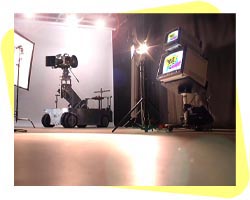
When needed, after a shoot we just cut a few feet off the bottom if it has become too dirty to re-use, and roll it back up. We use it a lot, and probably only have to buy a new one once a year or so. Ours right now will have to be cut before we use it again, as the bottom few feet is covered with motorcycle tire tracks from a previous shoot… but there’s still plenty left on the roll for next time.
T2
__________________________________
Todd Terry
Creative Director
Fantastic Plastic Entertainment, Inc.
fantasticplastic.com
-
[Dennis Size] “pet peeve of mine is when people are “filming” a short “film”….. but using the medium of video.”
Oh man, yeah, Dennis… that used to drive me up a tree.
I’m gradually getting over that, though… I guess I realized it’s a losing battle. I think it bothered me more when I was shooting a lot of film… now, not so much since HD and DoF conversion has taken hold.
I’m still very careful though to say “shooting” instead of “filming”… unless the medium actually has real sprocket holes. 🙂
T2
__________________________________
Todd Terry
Creative Director
Fantastic Plastic Entertainment, Inc.
fantasticplastic.com
-
Try istockphoto.com
They have great stuff, and are absolutely dirt cheap, especially when compared to Getty, etc.
T2
__________________________________
Todd Terry
Creative Director
Fantastic Plastic Entertainment, Inc.
fantasticplastic.com
-
My pleasure, Justin, I hope there was some useful info there.
Yes, a full-blown shootout would be cool… that would be especially useful among the lower-priced converters. I think at this point everyone is fairly aware that the P+S Technik works flawlessly, and the Redrock also works very well for a somewhat less-featured (and much less expensive unit)… but when you get down to the lower-priced units (Brevis, Letus, etc., and all their brethren) that’s where quality, results, design, and ease of usability can vary wildly.
At this point, the best we can really do is search individual reviews for those products… and some of them have recorded some really spectacular images… but just as common are the horror stories of difficulty of use with some of the different brands, as well as some real quality-control and design issues. A lot of it goes back to the old axiom “You get what you pay for.”
T2
__________________________________
Todd Terry
Creative Director
Fantastic Plastic Entertainment, Inc.
fantasticplastic.com