


Forum Replies Created
-

[Mark Suszko] “Mevo specifically was one I was thinking of. I might buy stock in that this year”
I don’t know if you meant that literally, but Mevo is from Livestream, a subsidiary of Vimeo, which is in turn a subsidiary of IAC (InterActiveCorp), a holding company that also encompasses the Match Group (Match.com, OKCupid, Tinder and others). They all trade on NASDAQ under the symbol IAC. Roughly tripled over the past four years, although down a bit from 52 week highs.
Another subsidiary of IAC, ANGI Home Services, includes Angie’s List. They do trade separately (NASDAQ: ANGI), but are down 75% since 2018.
I don’t know much more than that, but I don’t see an easy way to capitalize on what I agree is a pretty compelling pitch from Mevo, other than buying one of their cameras and making money from the videos you shoot. ☺ I can certainly imagine you making good use of Mevo for some of your performance videos!
-
As this story keeps twisting, Techcrunch raised the typically optimistic (and typically naive, I fear) notion that the current conditions may force (force? really?) ISPs to lift data caps forever. If they can lift data caps temporarily and nobody really suffers for it, they’ll be the ones pointing at their own emperor’s lack of clothes — the idea of “bad actors” sucking up the broadband and forcing the rest of us to slow down turns out to be less than a straw man and more of a flat-out lie.
Exuberance notwithstanding, a provocative read as he makes the case that there’s just no need for the caps that most of us had taken for granted: Coronavirus could force ISPs to abandon data caps forever
The larger issue for most of us isn’t the amount of data we pull down as the limits we face on download speed. The article makes an interesting case about how far down the shell game continues. Comcast has a gigabit plan for some folks, but it also comes with a 1TB data cap — which you’d blow through in three hours of top speed, give or take. After that, penalties come in, and speeds go down.
That’s my math, but I wonder if any of you are on this plan? Or any kind of truly high-speed connection? Definitely not me.
And fwiw, here’s a rundown of the major ISPs who are, and aren’t, lifting caps. I discovered that mine didn’t have a cap, but they’re offering free broadband to households with students who don’t already have access, and they’re throwing in a couple of weeks of Showtime and EPIX for everyone. Sure, thanks. Totally makes up for the slow, spotty service.
Anyway, now that we’re another couple of weeks along from where this conversation began, how’s your internet doing?
-
[Michael Gissing] “Only a couple of days ago a friend asked if he could borrow my BMPC4K to web stream and was after an ATEM mini so he could do in house concerts as a now totally impoverished musician. And now this update turns up. So I downloaded the camera software and will update it for him.”
What’s amazing to me about this story is that it’s EXACTLY how Grant started that part of the demo! By saying that people like the Pocket Cinema Cameras for what they are, and the form factor BEGS to be used for a portable stream matched with an ATEM Mini…and now the software update adds the feature set you need for a broadcast/streaming camera rather than a digital cinema camera.
And really, if he’s okay letting the computer do the streaming rather than the ATEM, and doesn’t need timecode sync across multiple cameras, he may be able to do everything he needs with the $295 Mini!
[Ricardo Marty] “I liked the atem mini but need a multiview this will give me more than what thought I could get.”
I still can’t get over that the multiviewer includes the graphic still store with up to 20 RGBA files. An insane amount of juice for USD$595!
-
[Oliver Peters] ” So he’ll try things that may or may not work perfectly – an absolute no-no in a standard product demo. “
Yeah, the standard demo would be something like already having the YT streaming key in hand, so there’s no dependency on YT actually delivering it to you, or having all the cameras plugged into a powered-up device. It’s wonderful that by being less slick, he’s actually more persuasive. You now know EXACTLY how long it takes to connect four cameras and power to an ATEM Mini Pro, and showing how easy it is to get a live streaming key is the kind of thing that might make someone who’s never tried it before think, “Wow, I can do that.”
[Michael Gissing] “I ran the whole station by myself for five hours before anyone wandered in and asked how it was going. I was 19. I see some of myself in Grant. Question everything, make it work better and most importantly more FUN.”
I think a lot of us do. Like you (and me), Grant was a teenager when he first got in a control room, him in high school iirc. When we spoke to him about the DaVinci acquisition, he spoke very happily about being driven to solve the problems of that young telecine operator that he was, and doing it in ways that were better and definitely cheaper than he’d seen other people do it.
I’m also thinking of something like the Teranex acquisition. He loved their stuff, but thought it was too expensive, too big, and too loud. So he made the converters smaller, quieter, added a bunch of features, and dropped the price from $70,000 to $1300, a reduction of 98%!!!! That’s all the money he needed to make from it, so that’s all he was gonna sell it for. We certainly talked about it at the time, but I honestly don’t think enough people either know or remember that.
Anyway, all this is why I felt it was worthwhile to talk about the presentation less formally than a real journalist (again, not me) would talk about a “proper” demo. My exuberance is an appropriate response to his. 🙂
-
[Michael Hoefler] “If we have to edit a confidential project we are editing it inhouse.”
This is one of the things that American producers will need to wrap their heads around in the future. Or they may decide not to, because the current status is working well enough….
…but the reality is that many VFX and post houses are contractually forbidden from connecting their project machines to the internet. Access to working suites are by keycard, and only a few people have access. ALL of them need to be onsite, even if only one at a time. There’s no getting around this.
Maybe that will work out well enough, but it seems unnecessary to me. It’s only a movie. The world won’t end if somebody sees a superhero’s new leotard a couple of months ahead of schedule, but business as a usual may well be a threat the stability of the republic going forward. We’re not there now, which makes this the perfect time to think about it. Why is secure VPN not secure enough? What’s the new, more secure protocol that we need?
Or is the problem that these guys just need to get their heads out of their own butts and decide that remote editing is something that they can conceptually live with. The only problems MIGHT be in their heads, but I’d need some of you folks to weigh in.
I’m especially interested in your thoughts on this, Mark. I know that Bunim/Murray isn’t Marvel, but you’re still working with material that’s worth a lot of dough to a lot of people, and you’re doing it all remotely. Can you comment on the IP security management issues that you’ve been talking about in-house without revealing any trade secrets?
[greg janza] “I use Resilio to keep two raids mirrored and it works extremely well.”
Greg, I noticed that Bob specifically mentioned Resilio as a solution that won’t work for a lot of people who don’t live in a good internet market. That’s pretty much the only kind I’ve ever lived in. LOL
Can you tell us a little more about where you are, what kinds of speeds you get, and the kinds of things that you’re doing with Resilio? I think we all have a lot more to learn about the difference between what’s on a company’s website, and how it’s working for customers in the world.
And Bob, if you have examples of folks who’ve tried Resilio and found it wanting in their specific applications, I’d sure love to hear about that too. Details, people! We need details! ????
-
[Michael Gissing] “….the big deal with the Pro is the built in hardware streaming encoder and the way you can go direct to FB, YouTube etc. But you are right. They are much more and are being used in broadcast and other non web applications”
Yep, agreed.
I’ve posted the press release coming out of this morning’s live stream here: Blackmagic Design Camera and Live Production News: ATEM Mini Pro, Blackmagic Camera and HyperDeck Software Updates

That’s my screencap of Grant at his most presenter-y, which I honestly get a kick out of.
I should mention that I was in fact watching this for kicks. Most definitely not in the context of my job here at the COW. A proper write-up of this sort is enough work that I go out of my way to avoid it. LOL Especially at 7am, which it was at my local time. I gotta tell you — I felt every second of my age trying to pay attention that early in the morning. LOL But pay attention I did. I even took notes!
Again, not officially. I was there as an old nerd. I knew from the minute I saw the inside of the control room in “A Hard Day’s Night” on NBC’s first broadcast of it as a schoolboy in 1967 that I wanted to work in television, and not a dozen years later, I was tech directing my first live TV.

(A Hard Day’s Night also inspired my love of cinematography, which had a lot to do with where my career bounced after starting as a TD. Still one of the most gorgeous movies I’ve ever seen; a nice take on its visual style here.)
So I was just watching Grant’s presentation as somebody who’s been a fan of this industry for over 50 years, and a participant for over 40. Sitting down groggily in my PJs and saying, “Tell me a story.” LOL
And as a former product manager who prided myself on giving demos as well as anybody in the company, I have mad respect for Grant being able to do genuinely engaging presentations for an insane number of products. (I think my most ever was 5 or 6 at a time, but he routinely blows past that.) Not only doing it live, but being willing to have any of his boo-boos immortalized.
Here’s some of what jumped out at me:
— Grant really is good at this, but you know what? So is Blackmagic. When he said that something was easy to set up, HE SET IT UP. As in, he started with a bare ATEM Mini Pro, and plugged in the power, four cameras, connected it to the internet shared with his laptop, got the streaming key from YouTube, and EVERYTHING ELSE, and he did it while speaking intelligently about the products.
I don’t know how many CEOs are up to this kind of thing, but I’ve worked with a lot of gear since I started in this business in the 70s, and I know that even you youngsters have too. There’s just not many people making this many things this easy to use.
— The ATEM Mini has a super-easy set of controls on the box itself that cover most of the bases. I’m sneaking ahead of myself and showing a picture of the new ATEM Mini Pro, but you get the idea.
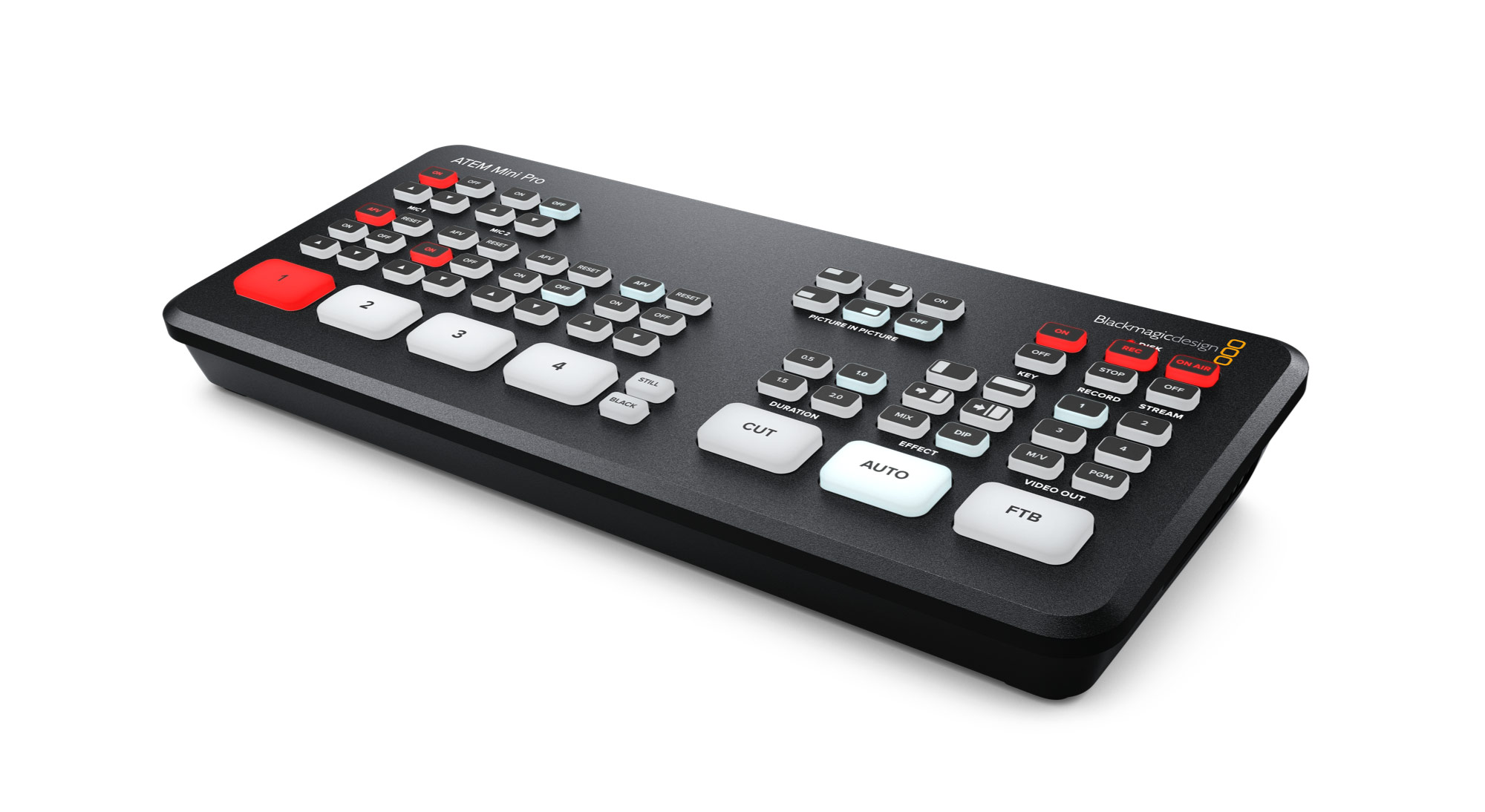
But where I started waking up a bit was when he showed the software running on his laptop that includes basically the wheels from DaVinci Resolve for setting up your cameras, and an audio page with the pertinent tools from Fairlight. It’s not that he’s loading ALL this stuff into an app for a $295 piece of hardware, but in classic BMD fashion, he’s taking the most directly applicable pieces, and assuming that you’ll do things with this that he hasn’t thought of.
That really is the quintessence of Blackmagic. Most other vendors create customer profiles, and they design for these theoretical constructs of potential uses. They do a really good job with that, but they’re not necessarily thinking about who they haven’t thought about.
I won’t say that Grant is necessarily designing for people he hasn’t thought about. Once he’s thought about them, the jig is up. LOL But he’s clearly more interested in creating potential scenarios that may yet emerge every bit as much as meeting specific needs that the company has already identified.
I like that.
— Here’s the first quote I wrote down: “Nothing about ATEM Mini makes it a low-end switcher.” He’s right! And that’s the $295 version!
So what’s the Pro part? In addition to some extra buttons, the big thing is built-in hardware encoding for streaming to YouTube, Facebook, Twitch, and others. By offloading this from the computer, you’re going to get a much cleaner compression, and much less likely to drop frames. You’re also only get to compression once, in the ATEM Mini Pro itself, rather than once in the webcam, again in the hardware, and again in the streaming software.
Other Pro features include recording the stream direct to USB flash disks in H.264, plus support for recording to disk, including a nifty demo of the HyperDeck with its FOUR disks, but really any disk fast enough to keep up with H.264, including a decent thumb drive.
— I mentioned that the software adds a ton of cool additional features, and one that nearly made me spit was MULTIVIEW, which also including a boatload of status indicators all on one screen. Again, my cap of the stream:

On the bottom row, note the “Record” monitor — combined views for the estimated TIME available for recording, and the available SPACE for the recording. Sweet!
Also, in the lower left, that’s a graphic with alpha, so the preview monitors include all the cameras AND the graphics store. And in classic switcher-y fashion, you can tie together the graphic through the linear keyer with one of the cameras, so you can bring up the vid+gfx with one control. Sweet again!
— One of my favorite parts of the demo: at one point, Grant yanked out the cable on the pocket drive he was recording to. Something you wouldn’t do on purpose, but that might happen when some lummox lumbers by. No worries! The recording is SAVED up until that very point. And he didn’t just SAY this. He SHOWED it.
This is why old bastards like me drag our flabby butts out of bed at the buttcrack of dawn to watch presentations like this for FUN. Because that there, my friend, that’s FUN.
— All the settings for the ATEM Mini Pro are contained in an XML file. You can add services, like pre-loading your streaming credentials, and if you’re responsible for setting this up for someone else, you can also DELETE settings, so that the end user doesn’t have a chance to monkey with them. Very, very thoughtful stuff for the technically inclined!
— I’ve always enjoyed Blackmagic’s transparency. They’re the first to admit that they’ve missed some ship dates over the years, but there’s no headscratching and shrugging here. “We started production today,” says Grant. WHAT? WHO SAYS THAT? And he admits that worldwide…uhm, conditions….make it a little trickier to name the date that you can get one in your hands, but hey, they’re rolling off the assembly line.
For $595. Nothing low end about this for that price, either.
Okay, now I want to make an observation about Grant’s observation about cameras. He said that they were getting a ton of requests from people to use Pocket Cinema Cameras for these kinds of remote productions where you’d want a switcher the size of a paperback book.
Needless to say, this is a pretty bad idea. LOL Blackmagic makes a line of nifty studio cameras of course, and sure, in a perfect world, people would pay for THOSE. But in the world we live in, people buy what they want, and the Pocket Cinema Camera is so much fun that people have ’em laying around….but they’re not especially well suited for this.
I mean, on one hand, they’re cool little cameras that punch above their weight. Dandy image quality, nice big viewfinders on the back that are bigger and have more control than most of the fold-out viewfinders on consumer-ish cameras, and terrific low light performance. Everything you’d want for a studio camera, except for everything you NEED in a studio camera. LOL These are CINEMA cameras. They’re wired for film gamut, RAW output, no tally, no sync timecode, on and on. All of this is addressable, but not easily, not for most people.
UNTIL TODAY. lol
I can tell you that I worked for a company where engineers would say things like, “BUT THAT’S THE WRONG WAY TO DO IT.” And I’m sure that somebody inside Blackmagic may have said such a thing. But what Grant showed is a FREE software update that fixes all kinds of these problems from the get-go.
You can use software control panel in the ATEM Mini Pro for all the kinds of CCU setup you want. Tint, focus, gain, shutter speed, iris, you name it. Color matching across multiple cameras, done. Shared timecode coming out of the ATEM Mini Pro’s built-in timecode generator (another new Pro feature), done.
With this free software update, the RECORD light on the front of the camera that shines red when you record NOW ALSO becomes a TALLY light: red when it’s on, yes, but also green for “ready” (ie,the camera that’s about to take) and orange for “standing by.” I really did drop my oatmeal this time.
You already know that the switched output from the cameras running through the ATEM Mini Pro can be both streamed AND recorded to disk simultaneously. But it’s still a CINEMA camera, so hey, go right ahead and attach a disk for ISO recording to BRAW in 4K or 6K, bypassing the LUT that you’ve applied for your pretty, broadcast-y HD stream.
It’s easy to imagine a program, say, a concert, where you want it to look “pretty darn good” for the broadcast of the live stream, but you want to really give it the full treatment of a cinematic grade to the RAW files in Resolve — done and done. There’s all kinds of workflow that becomes possible here.
“Possible” is the key word. That’s the scenario that immediately popped into MY mind, but who knows what popped into yours? (I can never figure out what’s going through y’all’s mind sometimes. LOL) So i dunno, what can YOU come up with to do with a switcher that fits in your hand that does simultaneous live streaming and recording to disk, coupled with freshly hybridized studio/cinema cameras recording ISO to RAW?
And here’s another place where the demo got insane, about 54 minutes into the hour — in fact, almost exactly where I took the screenshot at the top of this post. Here it is again so you don’t have to scroll all the way back up:
The ATEM Mini Pro really is a tiny fella, the tiny box on the desk in the lower right of the screencap, but it’s got a big giant brain. So Grant whipped out two 1 M/E panels from the full ATEM production switchers — but as configured here, they were only for controlling the ATEM Mini Pro. The idea is that you don’t have to page through screens on your laptop. You can set up some of the controls to be visible on the attached monitor, and leave the one page that you want on your laptop as the only one you need to worry about.
This is ideal both for people who happen to have full-scale ATEM studios and want the freedom to take some of that gear on the road, AND for people who want to start with the Mini Pro, and grow up into a full ATEM configuration with all the bells and whistles they want.
Look, I don’t know if any of this is helpful to you. I don’t know if I even meant for it to be helpful beyond the link to Blackmagic’s press release at the top of the post. I’m just talking nerd to nerd here, as a fan of this industry and a participant in many aspects of it for longer than many of you have been alive. Heck, longer than Grant Petty has been alive.
That’s fine by me, and if you don’t mind indulging me speaking as a fan here, I might take this approach with some of the other live streams coming up. I loved watching the presentation, and I’ve enjoyed taking longer to write up than it took me to watch it, without having to force the disciplines of actual journalism. I’ll leave that to Oliver. LOL
And having said all this, I’ll emphasize again what you already know, that I don’t know nuthin’ from nuthin’. I sat down in my jammies and said “Tell me a story,” and Grant told me a story…but it’s not like I’ve used any of this stuff. YOU tell ME. Have you used Blackmagic Pocket Cinema Cameras? Ready to consider them for studio use with appropriate software?
I also know that a ton of you have deep experience with streaming. How does this kind of switching solution look to you, including for use with your current HDMI cameras? Are you using Blackmagic’s streaming hardware? How does all this sit with you folks who are in the middle of it?
-
[Terry Barnum] “Do you happen to know which webcams these are?”
Hi Terry,
I’m sure there’s more than one, but one I’m familiar with is Mevo, a company that Vimeo acquired not that long ago, with this exact scenario in mind. The specific model is Mevo Plus, and as Mark mentioned, starts with a 4K source to extract the equivalent of multiple “views”.
There’s a bunch of other nifty stuff built in, like auto-framing moving subjects, and an iOs or Android app for switching “sources” with some options for letting the app do the switching itself if you don’t have someone free to operate the stream, various ways to connect to multiple streaming platforms, and other stuff you can take a speedy look here.
Some contents or functionalities here are not available due to your cookie preferences!This happens because the functionality/content marked as “Google Youtube” uses cookies that you choosed to keep disabled. In order to view this content or use this functionality, please enable cookies: click here to open your cookie preferences.
I’ve not used it myself, but there’s also a gallery at their site that shows a bunch of videos made with it, and I’m honestly impressed. Some great “multicam” music stuff that I especially dug, but also some nice interviews set up as a classic “two shot” that created a nice automatic version of a 3 cam shoot — 2 closeups and the master. It’s obviously not the same as true multicam, but for a few hundred bucks, it’s crazy clever. https://mevo.com/shot-by-mevo/
-
[David Lawrence] “(Tim, if you’re reading this, hit me up!)”
You better believe it! LOL “The Hit Up” email and phone call to follow!
-
[Oliver Peters] “The impact of the Asian market and Huawei.”
Also Samsung in Korea. I was interested that Parasite was edited with FCP 7, and I suspect that there are a ton of reasons for that, none of which I’ve seen anybody really talk about, because ultimately who cares. LOL But maybe because they don’t care about the newest Apple much of anything: iOS at under 11% and Mac under 5%:

OS market share in KoreaNot to paint Asia with too broad a brush, though, because Japan is almost as hot as the US for iOS, and HOTTER for Mac:

OS market share in JapanJapan, the US, and the UK really are exceptions. Check out India: 2%!!!

OS market share in IndiaGermany is better than that, but a lot closer to Korea: iOS under 15% and Mac under 10.

OS market share in GermanyStill doing better than South America, where I took a regional slice. Interestingly, the only region I came across where Mac is doing better than iOS, but still under 9% for Mac, under 4% for iOS:

OS market share in South AmericaAgain, all from https://gs.statcounter.com/, all February 2020 numbers.
I’m still comfortable generalizing that Apple has a lot to lose by overselling Mac to iOS customers….while still also agreeing with you that selling iPads to Mac customers as remote terminals makes a ton of sense.
Haven’t we seen individual apps demoing this? Am I wrong about that?
-
[Oliver Peters] “It would be great if within the OS – without any special app – I could directly operate a remote Mac as if I would running a machine right next to me. And with little or no latency. In an ideal world, I *should* be able to run a full-blown Mac Pro across the country, simply by using an iPad Pro.”
Ah, the return of the skinny client! I dig it!
In the context of Cupertino having a problem, and whether or not Cupertino agrees, it’s interesting to look at the big picture of market share. Worldwide, it looks like this (with Linux and “other” under these):

Android WAY in front of Windows and iOS, and certainly MacOS. In the US, it looks MUCH different, though, with iOS over 30%, Windows ahead of Android, but with Mac coming in really not all that much better at only 11%.

(btw, these are from StatCounter.com, where numbers nerds can have a LOT of fun slicing this in all kinds of different directions.)
The problem Apple has always had is that they can’t oversell the value of an inter-connected Apple ecosystem, because most people who buy iDevices are NOT running them with Macs. They’re connecting their iDevices to Windows machines more often, or using them strictly standalone. Any “Everything Apple” messaging that stretches much beyond iCloud or Apple email threatens to kill the Golden Goose, which is definitely iOS and its apps, rather than the desktop OS and its apps.
This isn’t a revenue graph of course, and I don’t mean to disregard the value of the laptop, iMac, and Mac Pro + monitors AND STANDS money to Apple. But it’s really, truly to Apple’s advantage to say, “Use as much or as little of our stuff as you want, and we’ll make it worth your while,” and pretty much leave it at that.
That said, I was using things like PC Anywhere in the very early 90s (the app actually dates back to 1986), doing pretty extensive remote operations over dialup. It seems crazy to me that Apple hasn’t addressed this in the broadband age. Why would they not?
There’s the heart of Mark’s original problem right there. He’s got a gazillion editors working on scazillions of shows (using round numbers here), and Apple doesn’t want to hear about it? Doesn’t want to help? I don’t get it.