


Queensland Performing Arts Centre Elevates Live Stream Experiences with AJA Gear

Performing arts centres across the globe have doubled down on live production infrastructure in recent years. For venues like the Queensland Performing Arts Centre (QPAC), the investment has more than paid off, extending its audience reach and improving accessibility to more people who may not be able to experience performances on-site at QPAC, while also saving on outside broadcast truck and satellite rental costs. Having initially built its live streaming and recording pipeline a few years ago, it’s now taking its production value one step further with a 4K HDR infrastructure overhaul. Anchoring the upgrade are colour management, conversion, streaming, and recording technologies from AJA.
“Our aim is to deliver content for clients that looks and sounds beautiful and allows their audiences to get the most out of their 4K HDR TVs and Dolby Atmos sound systems. This means we need to capture the best quality audio and video possible for live streaming and ensure that we have high-end source material to work with in post,” explained QPAC Audiovisual Manager Michael Wade. “While many clients leverage our in-house equipment to enhance monetisation efforts via streaming, they also use it to create marketing materials and to facilitate performance reviews. Our latest infrastructure upgrade enables them to do all this with exceptional video quality and colour; with some nice 4K lenses and our AJA gear, we’re able to achieve an aesthetic on par with expensive high-end cameras at a fraction of the cost.”
A unique live stream offering
Officially opening in 1985, QPAC today spans four, soon five, venues that cater to broad audiences, including the 1,800-seat Concert Hall and 280-seater Black Box venue. The Lyric Theatre hosts touring musicals, while the Playhouse hosts a range of art forms, including theatre, ballet, and opera.
Any artists, group, act, or organisation that uses QPAC facilities has access to its live streaming and recording services. Production deliverables vary based on the client and licensing agreements, but most performances and events are live streamed in 1080p H.264 SDR to the client’s website or to the Digital Stage platform, which QPAC set up on Brightcove. For higher profile performances, like the recent Ballet Preljocaj tour, Wade’s team may also live stream to other regional arts centres and venues.
Some clients simply want an H.264 recording immediately following the event for performance review. In other cases, Wade’s team makes a recording available for streaming or VOD (video on demand) viewing on Digital Stage. His team will also cut promos, highlight reels or social media teasers in a range of different formats and resolutions upon client request. Most often, this means they’re recording the ISO and main program feeds in Apple ProRes. All of this is made possible by the in-house setup Wade has built, removing the need for outside broadcast expertise to achieve similar outcomes.
The technology behind the stream
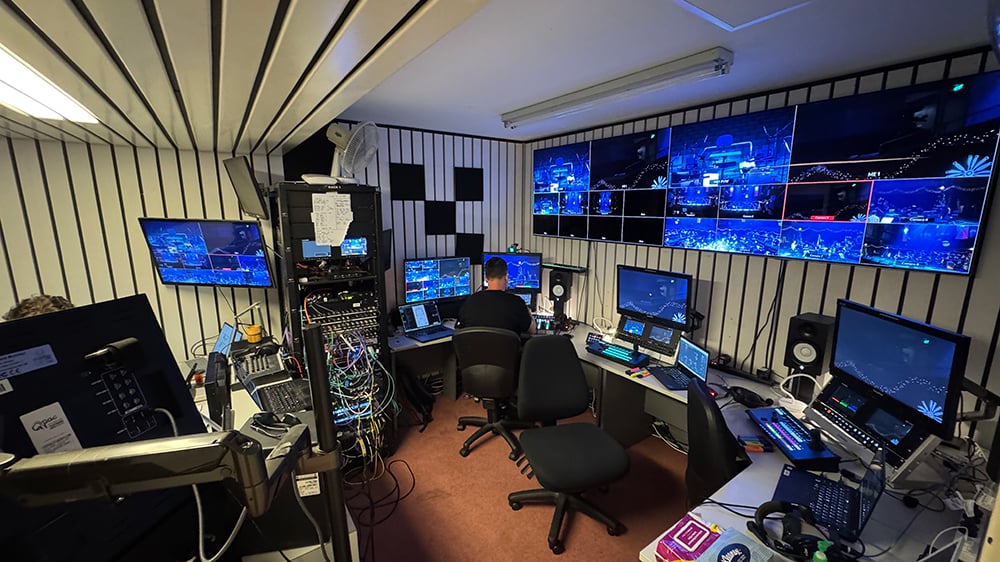
QPAC’s new infrastructure is impressive, with gear spread across multiple venues on campus. Each venue and the main control room house a RIEDEL MicroN signal interface. During events and performances, genlock signals are output to AJA C10DAanalog video distribution amplifiers and distributed to a mix of cinema and PTZ cameras. All camera control, Dante audio, and comms are also run through agnostic Ethernet tunnels to breakout switches.
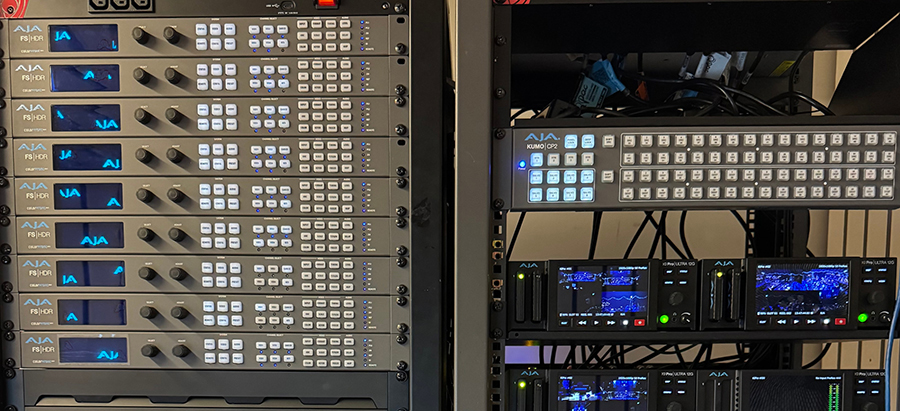
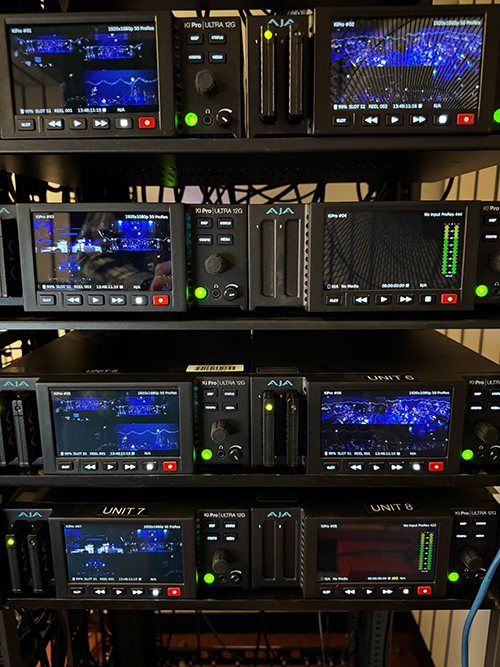
Camera feeds run through SMPTE fibre to a studio breakout box, where Wade and team patch outputs, sync, return vision, and tally to/from the MicroN. The signals then reach the control room, where they go directly into eight AJA FS-HDR frame synchronisers for colour matching. The FS-HDRs output to an SDI router, where Wade’s team can patch to their switcher and to AJA Ki Pro Ultra 12G recorders. If needed, they can also split the format to record ISOs in 4K HDR while switching and streaming in 1080p SDR and provide synchronisation and MADI audio embedding to SDI.
Using the FS-HDR, they apply a LUT and leverage the internal Proc Amp to adjust the white, black, and skin tones. For Audio, they take Dante or MADI to their audio suite, where they have a master clock and digital interfacing, which breaks out to a console where they do the mix and embed it with the video side using the MADI interface on the FS-HDR. To synchronise digital audio and video, QPAC uses an Antelope Trinity. A genlock split then goes to a Rosendahl MIF-4, which synchronises the frame rate to timecode (TC). Timecode is then sent to the recorders and studio equipment. The remote operations team uses Elgato Stream Decks to change monitor feeds and cameras, and they use in-house comms.
“Moving forward, we’d like to use five AJA ColorBoxes across venues as an inline LUT for colour matching across cameras or as a PGM output if they want to create a certain ‘look.’ This will allow us to free up our FS-HDR units for other important video processing tasks,” noted Wade. “We’ll also be able to throw a ColorBox on an output to apply an established ‘look’ to the master feed if required.”
For live streaming, the HELO Plus H.264 streaming and recording device is a core part of the workflow. “HELO Plus is such a dependable device that’s easy to program and compatible with just about anything, plus it handles compression on the fly,” Wade added. “We’re also exploring the possibility of integrating BRIDGE LIVE into our pipeline to support transcoding and streaming needs.”
Rounding out the infrastructure, AJA Mini-Converters like the C10DA and FiDO fibre optic converters address a number of conversion needs. FiDOs power a majority of the venue’s signal conversion. For editorial, they cut programming and other promotional materials in-house using a few Macs and a PC for graphics and animation. All audio is post-mixed and added to the video. “We use a lot of AJA gear across the board because it’s rock solid, and they offer great support,” noted Wade. “Their gear is affordable, and it performs as if it’s more expensive. Updates are regular and meaningful, and the free apps are very useful.”
Planning for the future
With the latest upgrade nearly wrapped, Wade is already thinking ahead, with an eye toward how the AV over IP evolution will play out in the coming months. “AV over IP is becoming more important. It’s certainly something we’re exploring and an area where technologies like AJA’s BRIDGE LIVE could really prove an advantage,” concluded Wade.
Find out more about the AJA technologies QPAC is leveraging.
Enjoying the news? Sign up for the Creative COW Newsletter!
Sign up for the Creative COW newsletter and get weekly updates on industry news, forum highlights, jobs, inspirational tutorials, tips, burning questions, and more! Receive bulletins from the largest, longest-running community dedicated to supporting professionals working in film, video, and audio.
Enter your email address, and your first and last name below!


Responses